Most HIEEC essays that fall short are not let down by weak ideas — they lose to avoidable mistakes a careful reader spots in minutes: no real thesis, the strict 1,500-word limit mishandled, evidence dropped in with no analysis, theory used for decoration, referencing left to the last hour. Because the strongest entries are judged by a Harvard economics professor, these errors carry a real cost. This diagnostic guide names the nine that most often sink capable writers, and gives a concrete fix for each.
Why a “mistakes” lens beats a “tips” lens
When you are revising a near-final draft, positive advice (“write a clear thesis”) is harder to act on than a failure to hunt for (“you have no thesis — here is how to tell”). HIEEC publishes no point-by-point rubric, so editing by elimination is the most reliable method: pass through your essay once for each mistake below, fix what you find, move on. The errors cluster into three families — argument, execution, and presentation — and they are roughly ordered by how badly each one hurts. Use this alongside the positive method in our guide to writing the 1,500-word essay.
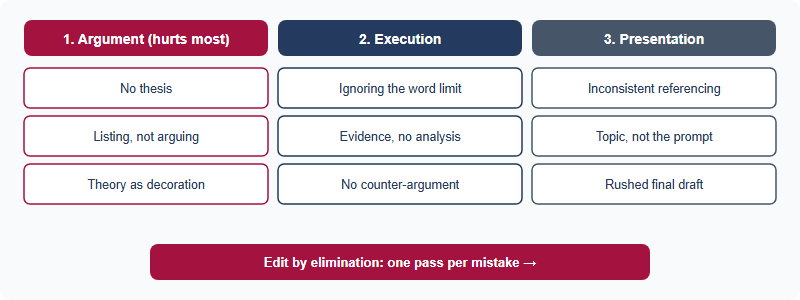
Family 1 — argument mistakes (these hurt most)
Mistake 1: No thesis. The essay surveys a topic (“there are several views on carbon taxes”) but never commits to a single arguable claim. Fix: write your thesis as one sentence you could defend or attack — “a carbon tax is the most efficient available tool for this externality, despite its distributional cost” — and make sure every paragraph serves it.
Mistake 2: Listing instead of arguing. Three causes, three effects, three policies — each described, none weighed. A list is not an argument. Fix: rank, compare, or choose. Tell the reader which factor dominates and why, rather than parading all of them at equal weight.
Mistake 3: Theory as decoration. Naming “game theory” or “elasticity” without building the model, so the term adds nothing. Fix: either develop the model properly — state its mechanism and apply it to your case — or delete the reference. Our overview of what HIEEC is stresses that an expert reader rewards correct, load-bearing theory above all.
Family 2 — execution mistakes
Mistake 4: Treating 1,500 words as a suggestion. The limit is strict, and anything over it is truncated — so an essay whose conclusion sits at word 1,600 simply loses its ending. Fix: draft long, then cut hard to a body comfortably at or under 1,500. If deleting a paragraph leaves your argument intact, it was not pulling its weight.
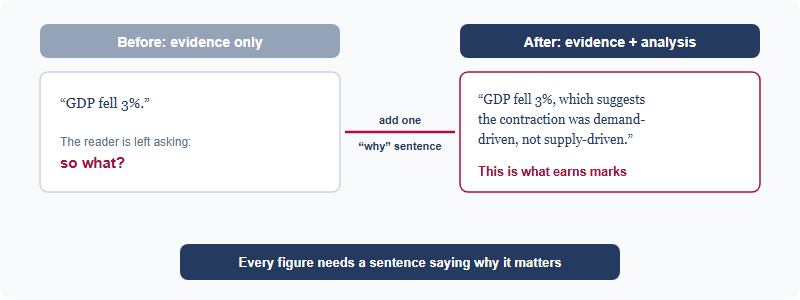
Mistake 5: Evidence with no analysis. A statistic is quoted, then the essay moves on — “GDP fell 3%.” So what? Fix: follow every piece of evidence with a sentence explaining why it supports your claim. Evidence is only as strong as the analysis attached to it.
Mistake 6: No counter-argument. A one-sided essay reads as advocacy, not analysis. Fix: name the strongest objection to your thesis and answer it. Engaging the best counter-case — not a strawman — is exactly what signals you can think like an economist. The most common trap here is the “two-sided” essay that gives both sides equal time and never decides; counter-argument means you address the objection and then reaffirm your position.
Family 3 — presentation mistakes
Mistake 7: Inconsistent or thin referencing. Mixing Chicago and APA, unattributed statistics, or a bibliography that does not match the in-text citations. Fix: choose one style and apply it throughout; attribute every figure; check that citations and the reference list correspond exactly. See our HIEEC overview for the format requirements (Chicago or APA, PDF).
Mistake 8: Writing the topic, not the prompt. The prompt asks a precise question, and the essay answers a broader, easier one nearby. Fix: re-read the prompt’s exact wording after drafting and confirm your thesis answers that question — not the general subject it belongs to. This is where many strong essays quietly lose: a brilliant essay on the wrong question scores below a solid essay on the right one.
Mistake 9: A rushed final draft. Submitting the first complete version, with the deadline — typically early January, but confirm the exact date and your own time zone officially — arriving before the editing does. Fix: finish the writing days early and reserve the final stretch for cutting, referencing, reading aloud, and formatting the PDF. The single most avoidable HIEEC mistake is treating the deadline as the writing date instead of the polishing date.
Two subtler mistakes that separate good from very good
Beyond the nine, two further errors rarely sink an essay outright but reliably keep a good one from being a finalist — worth a final pass once the basics are clean.
Wrong register — the op-ed voice. Economics essays are not opinion columns. An entry that reaches for rhetorical flourish (“the government must act now before it is too late”) reads as persuasion aimed at a general audience, when the reader is an economist who wants disciplined analysis. The fix is a register shift: replace emotive or campaigning language with measured, evidence-led claims, and let the strength of the argument — not the heat of the prose — do the persuading. A reliable signal you have drifted into op-ed mode is the appearance of words like “must,” “outrageous,” or “obviously”; an economist’s essay earns its conclusions instead of asserting them.
A weak conclusion that only summarises. Many essays spend their hard-won final paragraph restating what was already said. With a strict word budget, that is a wasted opportunity. A stronger conclusion does one more thing: it states the implication of the argument (what should follow if you are right), names a limitation or condition (what would change the answer), or points to the trade-off the analysis exposes. The reader should finish knowing not just what you argued, but why it matters and where its edges are.
A first-party pattern we see in China-based entries
Coaching international-school students in China, the recurring issue is not weak English or thin knowledge — it is over-inclusion. Strong students want to show everything they know, so they list causes, stack statistics, and name several models, and the 1,500-word limit punishes exactly that instinct. A second, related pattern is describing rather than deciding: a beautifully written tour of a policy debate that never tells the reader which side the writer comes down on. Both stem from the same impulse — to be comprehensive and balanced — and both read, to an economist, as a failure to commit. The students who place tend to do the opposite: one thesis, one core model, a handful of well-analysed pieces of evidence, one counter-argument answered, and a clear position held to the end. If you only fix one cluster before submitting, fix the argument family — a sharp, committed argument on the right question, at the right length, beats an encyclopaedic survey every time. For where this sits in the overall entry, start with our 1,500-word writing guide.
The 60-second pre-submission scan
| Ask yourself… | If “no” → |
| Can I state my thesis in one sentence? | You are surveying, not arguing — commit |
| Does every paragraph serve that thesis? | Cut the paragraph that does not |
| Is my main model built, not just named? | Develop it or delete the term |
| Does every statistic have a “why it matters” line? | Add the analysis sentence |
| Have I answered the strongest objection? | Add a counter-argument and rebut it |
| Is my body at or under 1,500 words? | Cut — the limit is strict |
| One referencing style, citations matching the list? | Fix consistency before exporting the PDF |
| Am I answering the exact prompt wording? | Realign the thesis to the question asked |
Frequently asked questions
What is the most common HIEEC essay mistake?
Submitting a rushed final draft. Finish the writing days before the deadline and reserve the end for cutting to 1,500 words, referencing, and formatting the PDF.
Do I really lose marks for going over 1,500 words?
The limit is strict and over-length text is truncated, so a conclusion past the limit can simply be cut off. Keep your body at or safely under 1,500; confirm counting rules officially.
Should a HIEEC essay include a counter-argument?
Yes. Naming the strongest objection to your thesis and answering it signals real economic thinking. A one-sided essay reads as advocacy rather than analysis.
How do I know if my theory is “decoration”?
If you could delete the model's name and the argument is unchanged, it was decorative. Build the model with its mechanism applied to your case, or remove it.
This is an independent guide to the Harvard International Economics Essay Competition, operated by Hanlin Education for China-based international-school students. We are not affiliated with, endorsed by, or sponsored by the Harvard Undergraduate Economics Association, the Harvard College Economics Review, or Harvard University. Word-count rules, the deadline, formatting and originality policy change by year — always confirm the current details on the official HUEA site. Confirmed errors are corrected within 7 working days.