Switching prompts is cheap in October and close to fatal in December, and the deciding factor is not how much you dislike your draft — it is which of four things has gone wrong. Two of them justify abandoning the prompt. Two of them will follow you to the next one. Diagnose before you decide, because the wrong switch costs you the season.
Why “just keep going” is bad default advice
Most guidance on this question collapses into one of two slogans. Teachers say persevere; students on forums say start over. Both are useless because neither asks what is actually broken. A draft can fail because you chose a question that cannot be argued, which no amount of perseverance repairs, or because your paragraphs are muddy, which switching prompts will reproduce exactly.
The timing matters as much as the diagnosis. HUEA’s competition page, when we read it in September 2026, gave the submission deadline as January — a month, with no date and no time zone stated. Everything below is therefore expressed in weeks before whatever date the organisers publish. Count backwards from that date once it appears on thehuea.org, not from this article, and do not assume a date from a previous cycle carries over.
One more thing the page did not state: whether a student may submit more than one essay. We could not verify a rule either way, so treat “I will just enter both prompts” as unavailable until you have confirmation from the organisers. Plan on the assumption that you are choosing, because that is the assumption that makes the choice serious. If you have not yet made a first choice at all, our guide to choosing a prompt by strength rather than by topic appeal is the earlier decision this article assumes you have already made.
Diagnose first: four failures, and only two of them travel
Before you touch the decision, write down what specifically is wrong in one sentence. Students almost always describe the symptom — “it feels weak” — when the useful work is naming the cause. The table below maps the symptoms we see most often in autumn drafts onto the underlying failure and the correct response.
| What you notice | What it actually is | Switch prompt? | Do this instead |
|---|---|---|---|
| You cannot state your claim in one sentence without joining two ideas with “and” | No argument — you have a topic, not a proposition someone could disagree with | Yes, if the prompt itself resists a single arguable claim | First try re-cutting the question. If three attempts fail, the prompt is wrong for you |
| The evidence you need does not exist, sits behind paywalls, or rests on one contested study | Evidence unavailable — the argument is fine in the abstract and unsupportable in 1,500 words | Yes, if no substitute case exists | Change the case study first; switch the prompt only if every case has the same problem |
| The argument is clear to you but readers keep asking what you mean | Prose failure — a writing problem wearing an argument costume | No | Rewrite the mechanism section in short sentences. This follows you to any prompt |
| Everything you write feels obvious once it is on the page | Scope too wide — at that altitude every true statement is banal | No | Narrow the question inside the same prompt (see below) |
| You have lost interest in the topic | Fatigue, usually at the literature stage, which is the least enjoyable stage of any project | Almost never | Draft one section badly and on purpose. Interest usually returns with momentum |
| Someone else at your school chose the same prompt | Not a problem — entrants choose from a published set of prompts, so overlap is common | No | Nothing. Your question inside the prompt is what differentiates you |
The distinction that does most of the work here is between a prompt and a question. HUEA states that entrants choose one prompt from a set on the big questions in economics. A prompt is broad by design; the question you write inside it is yours. Most students who believe they need a new prompt actually need a new question, and the second operation costs a fraction of the first.
What carries over, and what is genuinely sunk
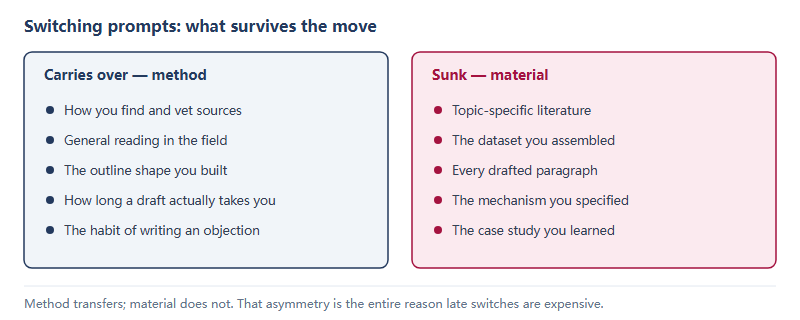
This is where sunk-cost reasoning is usually applied badly. The economics-student instinct is to say that sunk costs are irrelevant to a forward-looking decision, and in the abstract that is right. But the relevant forward-looking quantity is not “hours already spent” — it is hours still required, and those differ enormously between the two options. Continuing needs revision hours. Switching needs reading hours, and reading is the slowest stage of an economics essay. So the honest version of the decision rule is not “ignore what you have spent”; it is “compare the remaining work on each path against the weeks you have left.”
The cost curve: measured in weeks before the deadline
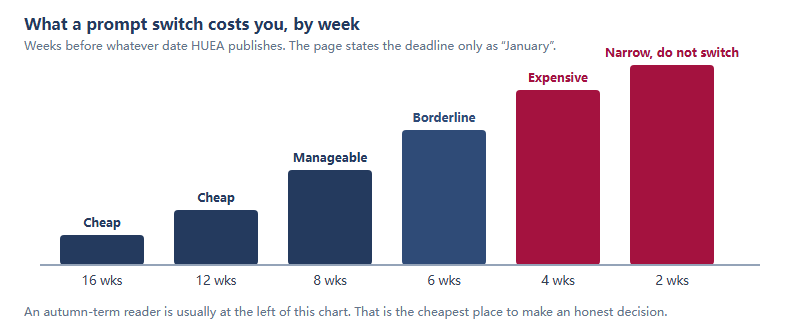
Translated into rules you can act on:
- 12 weeks or more out. Switching is affordable. If the diagnosis says the prompt cannot carry an argument or the evidence is not obtainable, switch now and do not agonise. You have time to read a new literature properly.
- 8 to 12 weeks. Switch only for the two prompt-specific failures. Budget a full week purely for reading before you write a word, and accept that your revision phase will be shorter than you wanted.
- 6 to 8 weeks. Borderline. Switching here usually means one draft and no real revision, which is a poor trade unless the current draft has no argument at all. Prefer narrowing.
- Under 6 weeks. Do not change prompt. Change the question inside it. A narrowed question reuses your reading, and reading is what you no longer have time to redo.
- Under 3 weeks. Freeze scope entirely. Spend the remaining time on the objection section and the close, which is where marginal effort still improves an essay this late.
If you are reading this during the autumn term, you are almost certainly on the left-hand side of that chart, and that is the point of publishing it now. The students who end up trapped at four weeks are rarely the ones who reconsidered in October; they are the ones who suspected in October and postponed the conversation until December, when the only honest options had disappeared.
The salvage route: narrow instead of switch
Narrowing keeps the prompt, keeps your reading and changes only the altitude of the question. It solves the two failures that switching cannot — obviousness and vagueness — and it costs days rather than weeks. The move is to add constraints until the answer stops being predictable.
The chain below is invented for illustration and is not a real prompt from any cycle; treat it as a demonstration of the operation rather than as guidance about content:
- Too broad: “How is automation changing the labour market?” Every true answer is banal, and 1,500 words cannot survey a field.
- Narrower: “Does automation compress or widen the wage gap between experienced and junior workers?” Now there is a disagreement to resolve, but still no case.
- Workable: “In one occupation where assistance tools were adopted quickly, did the least experienced workers gain more than the most experienced — and what would that imply for entry-level hiring?” One mechanism, one testable direction, one consequence.
Notice that the prompt never changed. The reading you did for version one is still valid for version three; you have simply stopped trying to cover the field and started trying to settle one disagreement inside it. That is also, incidentally, what makes an essay feel original without needing an exotic topic — and it is why the “everything I write is obvious” symptom is a scoping problem rather than an imagination problem.
Two cautions on the switch itself, if you do make one. First, do not switch towards a prompt because you imagine it is less popular. You cannot observe how many entrants choose each prompt, no such figures were published on the competition page when we checked, and HUEA states in any case that every entry is read by its board before the strongest go to a Harvard economics professor. Popularity is not a channel you can game. Second, do not switch to a prompt you have never read anything about on the assumption that a fresh start will feel better; it will feel better for about four days, which is roughly when the reading begins.
Whichever path you take, the fixed constraint is unchanged: around 1,500 words, one prompt, one argument, delivered against a January deadline you should confirm on thehuea.org. Our walkthrough of building the essay inside that limit covers what the rebuilt draft has to do, and the overview of what HIEEC asks for sets out the rest of the frame.
Frequently asked questions
Can I just enter two prompts instead of choosing?
The competition page did not state an entries-per-student rule when we checked. Do not assume multiple entries are allowed — confirm on thehuea.org.
How late is too late to switch prompts?
Under six weeks before the deadline, narrow the question inside your current prompt instead. Switching then usually costs you the revision phase.
My draft feels weak but I cannot say why. Switch?
Not yet. Try stating your claim in one sentence. If you cannot without using “and”, the problem is the question, not the prompt.
Does choosing a popular prompt hurt me?
No published figures show prompt popularity, and HUEA states every entry is read. Your question inside the prompt is what differentiates the essay.
This is an independent guide operated by Hanlin Education for China-based international-school students. We are not affiliated with, endorsed by, or sponsored by the Harvard Undergraduate Economics Association, the Harvard College Economics Review, or Harvard University. Prompts, word limits, deadlines and entry rules are set by the organisers and change each cycle — confirm current details on thehuea.org. Factual corrections are made within 7 working days.