For many students preparing for the Harvard International Economics Essay Competition (HIEEC), the term “literature review” triggers anxiety. It often conjures images of dry, chronological summaries where Source A said this, and then Source B said that. However, in the context of a high-stakes economics essay competition, a literature review is not a book report; it is a strategic map of the intellectual terrain you are about to navigate. The most effective way to organise your evidence is not by date or author, but by disagreement. This approach allows you to demonstrate critical thinking, identify gaps in existing knowledge, and position your own argument as a necessary resolution to a live debate.
When Chronology Helps and When It Hides the Argument
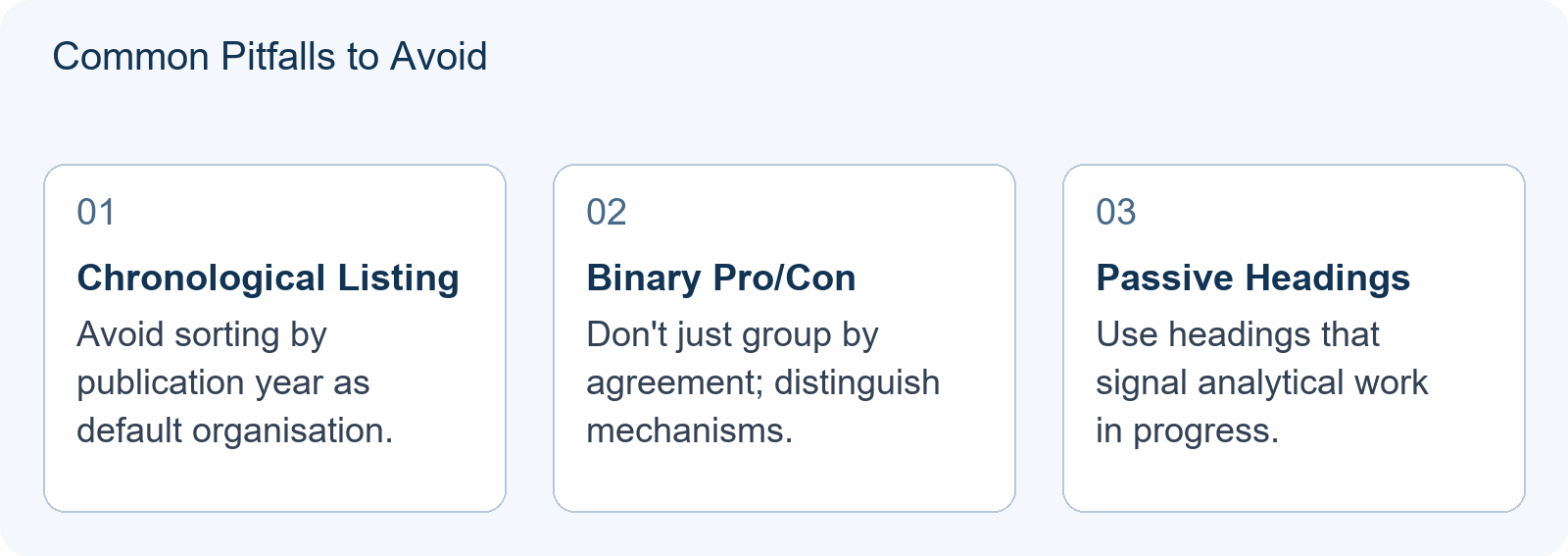
A common mistake among novice competitors is treating the literature review as a timeline. You might start with classical trade theory, move through Keynesian macroeconomics, and end with modern behavioural economics. While this shows breadth, it can fail to show depth or analytical capability if the dates themselves become the organising principle. HIEEC judging criteria emphasise the ability to synthesise complex ideas. A chronological list does not synthesise; it merely accumulates. If your essay prompt asks about the efficacy of carbon taxes, listing papers from 1990, 2005, and 2023 without connecting their arguments leaves the reader wondering why those dates matter.
However, chronology is not automatically weak. When you are explaining the development of a theoretical framework—how a model evolved from its original formulation to incorporate new constraints—temporal ordering can illuminate why certain assumptions were relaxed and why new methods emerged. The key distinction is purpose: use chronology to show intellectual development, not as a default filing system that obscures the current state of debate.
Furthermore, chronological organisation often obscures contradictions. If an early paper argues that minimum wage hikes increase unemployment, and a later paper argues they do not, placing them sequentially makes it seem like one simply superseded the other due to better data. In reality, they may disagree on theoretical assumptions, empirical methods, or the populations studied. By organising around disagreement, you highlight these methodological clashes, which is precisely the kind of nuance that distinguishes winning essays from average ones.
Mapping the Debate: Three Axes of Disagreement
To organise your evidence effectively, identify three distinct axes along which economists disagree regarding your chosen topic. These axes should be derived from the core tension in your essay prompt. For example, if the prompt concerns automation and labour markets, the axes might be:
- Theoretical Mechanisms: Do economists agree on why job displacement occurs? Some argue it is purely technological substitution, while others emphasise capital-labour complementarity.
- Empirical Magnitude: Even if they agree on the mechanism, do they agree on the scale? One study might find a 5% reduction in wages, while another finds 20%. This discrepancy often stems from different datasets or time periods.
- Policy Implications: Given the same facts, do experts recommend universal basic income, retraining programs, or no intervention? This reveals value-based or ideological divergences that influence economic modelling.
By structuring your paragraphs around these axes, you create a logical flow. Paragraph 1 addresses the theoretical split. Paragraph 2 addresses the empirical variance. Paragraph 3 addresses the policy divergence. This structure forces you to engage with the literature actively, rather than passively reporting it.
Teaching Illustration: A Fictional Minimum Wage Debate
[Teaching Illustration — Fictional Studies A and B for Method Demonstration]
Let us apply this method to a hypothetical HIEEC prompt: “Does raising the minimum wage reduce employment?” A superficial review would list Study A (finding small effects) followed by Study B (finding larger effects). A disagreement-focused review organises the evidence by methodological conflict.
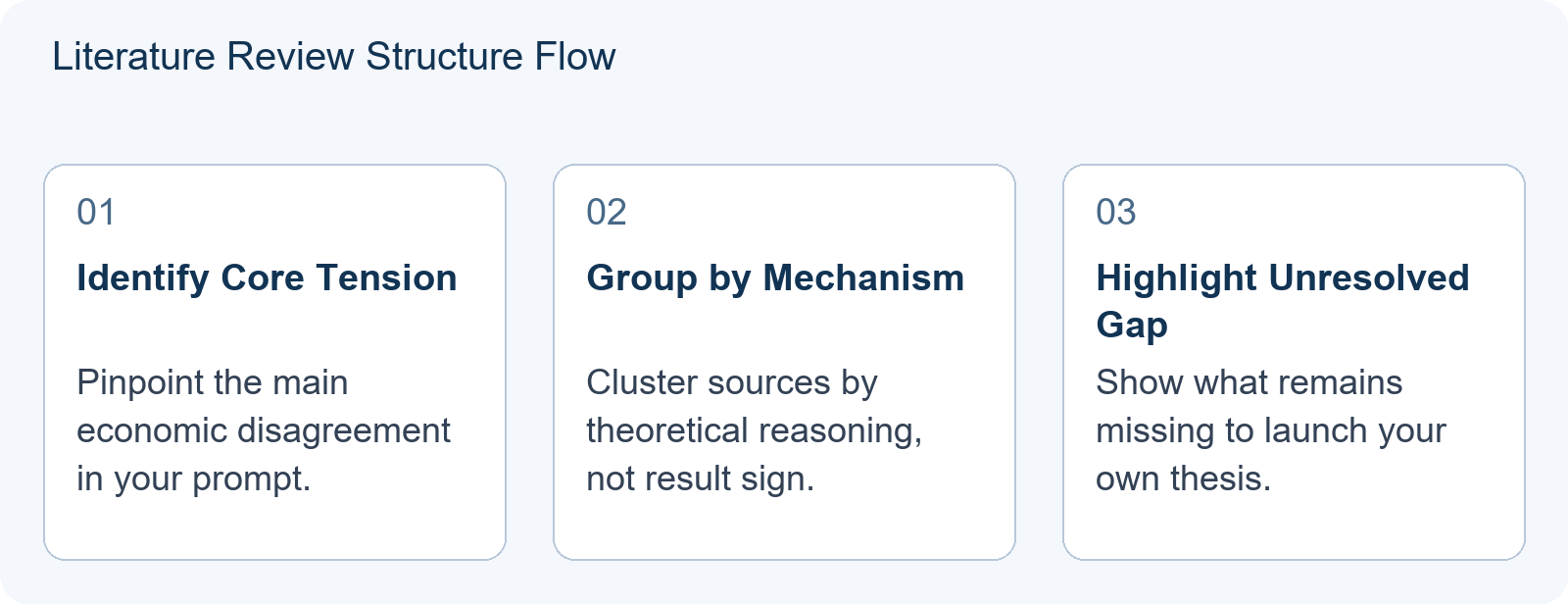
Step 1: Identify the Core Disagreement. The central dispute is not just about the result, but about the validity of the research design. Consider two fictional studies:
- Study A (Fictional): Examines contiguous counties across state borders with different minimum wage laws, using restaurant employment data from 2010–2018. Identification relies on the assumption that cross-border county pairs face similar economic shocks.
- Study B (Fictional): Uses national panel data with state-specific linear trends, covering all sectors from 1990–2019. Identification relies on the assumption that unobserved state-level factors trend linearly.
Step 2: Group Sources by Methodological Approach. Create a section titled “Border-Discontinuity Designs.” Here, you discuss studies that favour geographic quasi-experimental designs like Study A. You note that these studies often find minimal employment effects in the restaurant sector. Then, create a section titled “Panel Data with Trend Controls.” Here, you discuss studies using broader national panels like Study B, which may find more negative effects when applied to all sectors.
Step 3: Analyse the Conflict. Instead of saying “One says yes, one says no,” you explain why they disagree. Study A’s design may capture local labour market adjustments but cannot speak to aggregate effects. Study B’s design offers broader coverage but assumes linear trends may miss nonlinear shocks. Neither methodological camp determines the sign of the result by itself; the divergence arises from differing populations (restaurants vs. all sectors), time periods (2010–2018 vs. 1990–2019), outcome measures (employment levels vs. employment-to-population ratios), and identification assumptions (parallel trends across borders vs. linear state trends). This analysis demonstrates that you understand the limitations of each evidence type, a key skill for HIEEC judges.
Contrasting Case: Where Superficial Organisation Fails
Consider a contrasting case where a student organises by “Proponents vs. Opponents.” They group all authors who say “minimum wage is good” together, and all who say “it is bad” together. This seems intuitive but is analytically weak. Why? Because two authors might both say “it is good” for entirely different reasons. Author A might say it is good because it increases consumer spending (Keynesian view). Author B might say it is good because it reduces turnover costs (Monopsony view).
If you lump them together, you miss the crucial distinction between demand-side and supply-side mechanisms. When you later try to propose a policy solution, you will lack the precision to know which mechanism your solution targets. The “Proponents vs. Opponents” binary flattens the complexity of economic theory. Judges will perceive this as a lack of deep understanding. In contrast, organising by mechanism (Demand-Side Arguments vs. Supply-Side Arguments) preserves the theoretical integrity of the evidence, allowing for a more sophisticated conclusion.
Diagnostic Application: Testing Your Structure
How can you tell if your literature review is organised around disagreement rather than summary? Use this diagnostic test on your current draft outline.
Test Question 1: Can you remove any single paragraph without breaking the logical chain? If yes, that paragraph is likely redundant summary. In a disagreement-focused review, every paragraph should advance the resolution of a specific conflict.
Test Question 2: Do your section headings reflect active analytical work? Headings like “Early Studies” or “Recent Papers” are passive. Headings like “The Conflict Between Static and Dynamic Models” or “Disagreements Over Elasticity Estimates” signal that you are doing analytical work. If your headings are passive, rewrite them to reflect the argument.
Test Question 3: Is there a clear “gap” identified? After presenting the disagreement, you must explicitly state what remains unresolved. For example: “While both camps agree on X, neither has adequately addressed Y under conditions Z.” This gap is the launchpad for your own thesis.
Integrating Data Sources into the Argument
It is important to distinguish between primary data and secondary literature. Your literature review primarily handles secondary sources (academic papers, reports). However, HIEEC essays often require original data analysis. Do not mix these in the review section. Keep the literature review focused on what others have found and argued. Save your own data collection and analysis for the methodology and results sections.
However, you can use the literature review to justify your choice of data. For instance, if previous studies disagree on which dataset best represents local labour markets, you can cite that disagreement to explain why you chose a specific source. This links the review directly to your practical decisions, showing that your research design is informed by the scholarly conversation.
Credible sources need not be exclusively peer-reviewed academic journals. Depending on your claim, institutional reports from central banks, OECD, or reputable think tanks may carry significant weight. The key is matching source credibility to the claim being supported, not applying a categorical rule.
Next Steps for Preparation
Organising evidence around disagreement requires practice. Start by taking a simple economic question, such as “Do trade agreements benefit developing nations?” Find five academic abstracts. Do not read the full papers yet. Instead, categorise the abstracts by their main claim and their implied counter-claim. Draw lines between conflicting claims. This visual mapping exercise helps internalise the logic of disagreement before you begin writing.
Remember, the goal of the HIEEC literature review is not to prove you have read everything. It is to prove you can think critically about what you have read. By framing evidence as a series of resolved and unresolved conflicts, you transform a static list of citations into a dynamic argumentative foundation. This approach aligns with the expectations of independent guides and academic mentors who advise that clarity of thought outweighs volume of citation.
For further guidance on selecting relevant topics and managing word counts, refer to How to Choose Your HIEEC Prompt (by Strength), 2026 and HIEEC Essay Preparation Without School Economics: Where to Start. Additionally, understanding what judges specifically look for in argumentation is covered in What HIEEC judges look for.
Frequently Asked Questions
How long should the literature review section be in an HIEEC essay?
There is no fixed length prescribed by official rules. The focus should be on quality of synthesis rather than quantity of sources cited. A useful guideline is to ensure your review covers the main theoretical and empirical debates with enough depth to position your own argument, typically requiring several paragraphs but not dominating the essay.
Can I include non-academic sources like news articles in my literature review?
The literature review should primarily focus on academic and institutional sources. Credible non-peer-reviewed sources—such as central bank reports, OECD analyses, or reputable think tank publications—can matter depending on the claim you are supporting. News articles may be used for context or to illustrate real-world events but are generally insufficient for theoretical argumentation.
What if all the sources I find agree with each other?
True consensus is rare in economics. If sources appear to agree, look deeper for differences in methodology, sample size, geographic scope, or time period. If genuine consensus exists, your essay should explore why that consensus holds, what assumptions underpin it, or whether the consensus applies to all conditions relevant to your prompt.