Monetary figures in HIEEC essays—from wages to GDP—are not directly comparable across years because a dollar in 2024 buys less than a dollar in 2010 due to inflation. Failing to adjust for price changes leads to misleading comparisons where nominal stability masks real decline. This guide explains how to use real and nominal data correctly, ensuring your temporal comparisons reflect actual purchasing power rather than just cash amounts.
HIEEC’s 2026-27 choices cover AI, globalization, digital economy, environment, inequality, and an own-question option, so temporal comparisons appear in many possible questions. That makes correct data handling part of the argument itself, not a cosmetic detail. This article gives you a practical method for using HIEEC real and nominal data: when to convert, how to label figures, and how to avoid the most common inflation mistake within a strict word limit.
The Trap: Why ‘$50 Billion in 2020’ Is Not Comparable to ‘$50 Billion in 2024’
Economic data is often reported in nominal terms, meaning it reflects the prices at the time of measurement. If you compare a nominal figure from 2020 directly with one from 2024, you are comparing values measured in different price levels. A government programme that cost $50 billion in 2020 and $50 billion in 2024 appears identical in nominal terms. But if prices rose over those four years, the later $50 billion likely purchased fewer real goods and services than the earlier $50 billion.
That matters for policy evaluation. Suppose you argue that a programme became less efficient because its nominal cost stayed flat while its outputs fell. The nominal cost figure alone does not prove that. You would need to ask whether the real resource cost changed, whether the price index for the programme’s inputs rose faster than general inflation, and whether the output measure is itself nominal or real. A nominal comparison can support a claim about cash outlays, but it cannot by itself support a welfare claim about purchasing power.
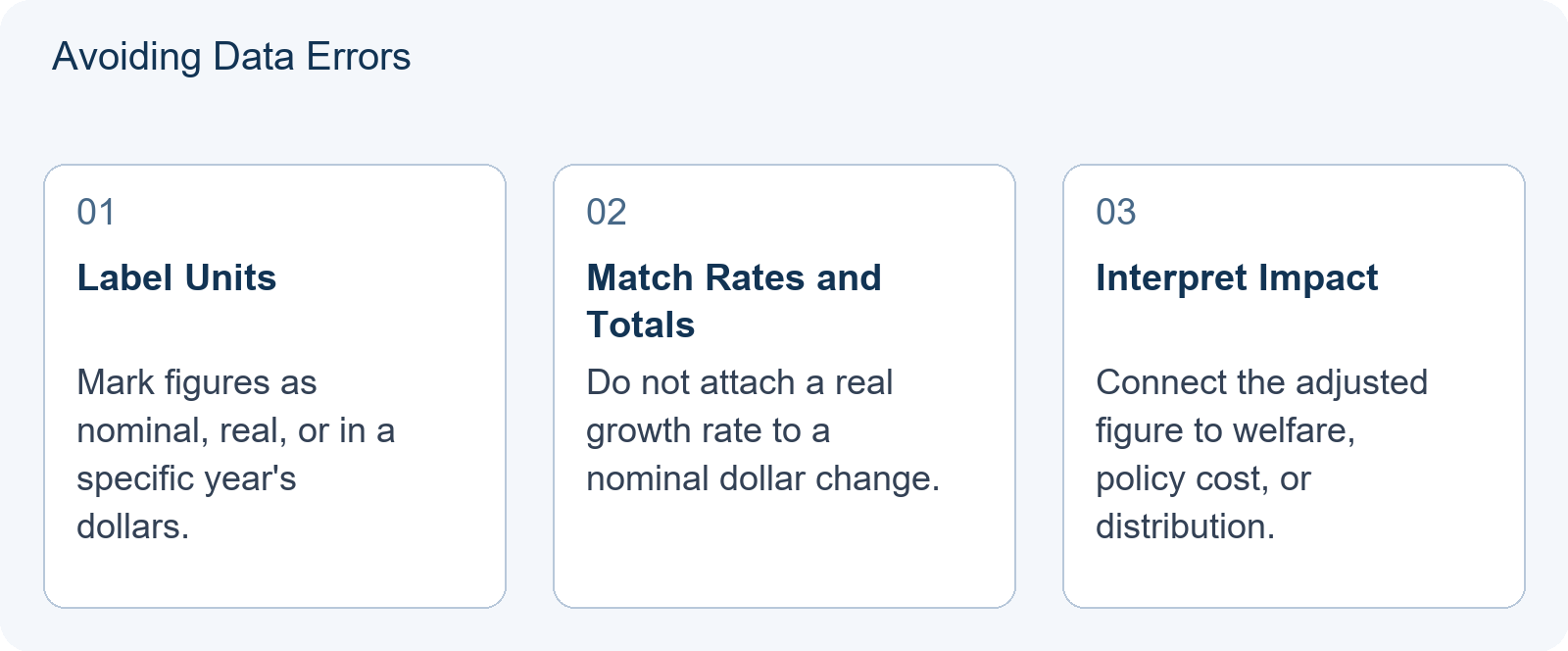
This is why clear data labels help a reader follow your argument. A sentence such as ‘spending rose by $10 billion’ is incomplete for a temporal welfare argument. A stronger sentence is: ‘Spending rose by $10 billion in nominal terms, but after adjusting for inflation it was broadly flat in real terms.’ The second version tells the reader exactly what changed.
Defining Nominal vs Real: A One-Sentence Rule for Your Essay
Use this one-sentence rule: Nominal values are measured in current prices, while real values are adjusted to remove the effect of price changes and are expressed in the prices of a chosen base year.
When discussing growth, purchasing power, welfare, real wages, or long-run policy impact, real data is usually the right choice. When discussing immediate financial obligations, such as a fixed interest payment due this year, a nominal figure may be appropriate because the actual cash amount matters. The key is consistency. If you cite a real GDP figure, do not silently mix it with a nominal income figure. If you use a nominal debt total, explain why current dollars are the relevant unit.
You do not need a long definition in the essay. One parenthetical label can do the work: ‘in 2010 dollars’, ‘real terms’, or ‘nominal, not inflation-adjusted’. The reader needs to know which comparison you are making, not a textbook history of price indices.
Step 1: Identify the Base Year for Your Comparison
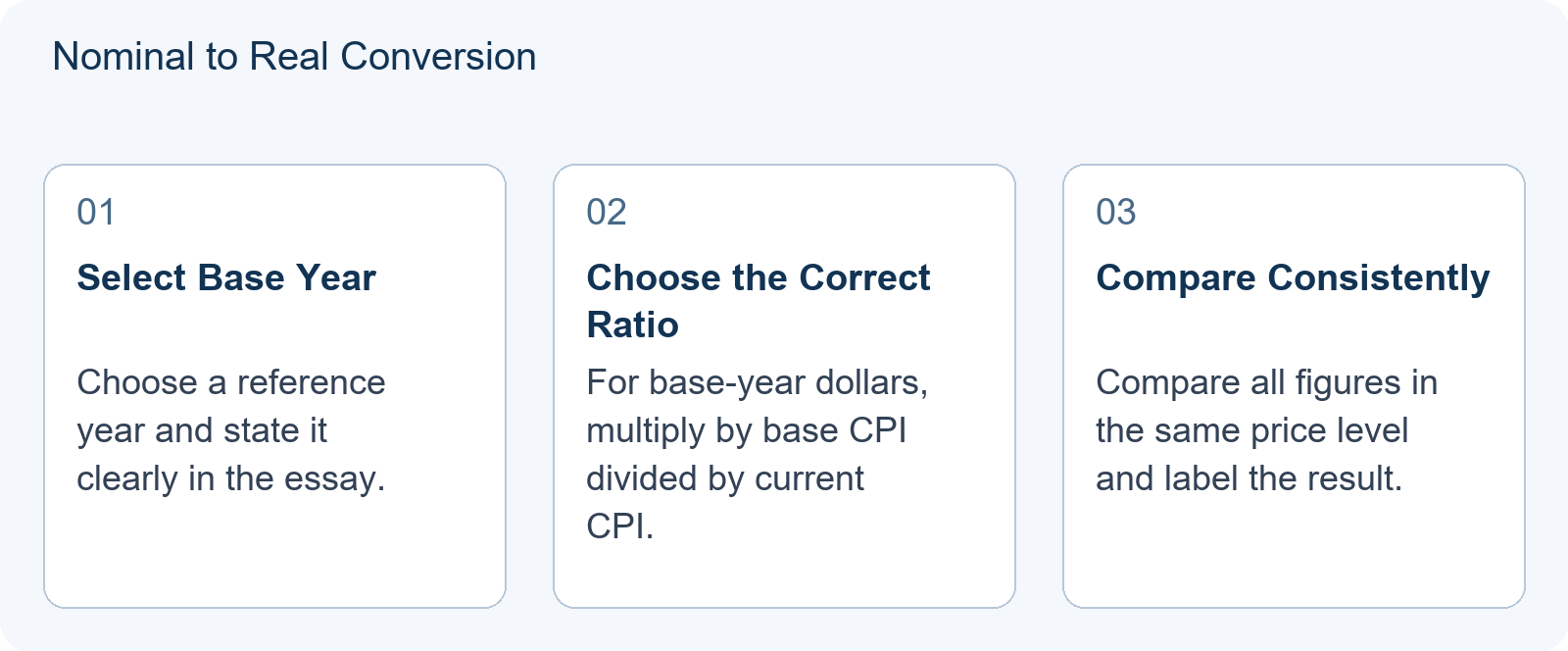
Before converting any data, choose a base year. The base year is the reference point where prices are held constant. If you choose 2010 as the base year, all real values are expressed in 2010 prices. If you choose 2020, all real values are expressed in 2020 prices. Either can be valid, but you must state it and use it consistently.
For example, if you compare minimum wage levels from 2000 to 2020, you might choose 2010 as the base year. A 2020 wage converted into 2010 dollars tells you what that 2020 wage would have been worth at 2010 prices. That is useful for asking whether workers could buy more or less than in 2010. Alternatively, you might express the 2000 wage in 2020 dollars. That answers a slightly different question: what would the older wage be worth at today’s prices?
Both methods are legitimate if labelled correctly. The mistake is to switch base years without telling the reader, or to compare a 2010-dollar figure with a 2020-dollar figure as if they were the same unit.
Step 2: Apply the Price Adjustment (Simple Illustration)
Once you have a base year, use a price index such as the Consumer Price Index (CPI) or a GDP deflator. Two formulas cover most student needs:
To convert a nominal value from year t into base-year dollars:
Real value in base-year dollars = Nominal value in year t × (CPI of base year / CPI of year t).
To convert a base-year value into current-year-dollar equivalent:
Current-year-dollar equivalent = Base-year value × (CPI of year t / CPI of base year).
Teaching illustration, not an official HIEEC prompt: suppose the nominal minimum wage in 2010 was $7.25, the CPI in 2010 was 218, and the CPI in 2020 was 258. The 2010 wage expressed in 2020 dollars is $7.25 × (258 / 218) ≈ $8.58. If the nominal wage in 2020 were still $7.25, its real value in 2010 dollars would be $7.25 × (218 / 258) ≈ $6.13. The nominal paycheck is unchanged, but its purchasing power is lower. That is the kind of adjustment that turns a static fact into an economic argument.
Notice the direction of the ratio. If you want to move an older value forward into today’s prices, multiply by current CPI divided by base CPI. If you want to move a current value back into base-year prices, multiply by base CPI divided by current CPI. Mixing these up is one of the most common arithmetic errors in student essays.
Worked Example: Comparing Minimum Wage Increases Across Two Decades
Teaching illustration, not an official HIEEC prompt: a country raises its minimum wage from $10 in 2010 to $15 in 2020. On the surface, that is a 50% nominal increase because ($15 − $10) / $10 = 0.50. Suppose the CPI was 200 in 2010 and 260 in 2020, so the price level rose by (260 / 200) − 1 = 30%.
To compare real purchasing power, convert the 2020 wage into 2010 dollars: $15 × (200 / 260) = $11.54. The real increase is ($11.54 − $10) / $10 = 15.4%, not 50%. Equivalently, the 2010 wage in 2020 dollars is $10 × (260 / 200) = $13.00, and $15 is about 15.4% above $13.00. So the correct sentence is: ‘Nominal wages rose by 50%, but real wages rose by about 15% after adjusting for inflation.’
That sentence is shorter than a full explanation and much stronger than an unadjusted claim. It also protects you from a common objection: a reader could otherwise ask whether the wage increase merely kept pace with rising prices. By converting to real terms, you answer that question before it is raised.
When to Use Nominal: Cases Where Current Prices Matter
Real data is not always the right choice. Nominal figures are appropriate when the actual cash amount in a given year is the object of analysis. If a government owes $1 billion in interest this year, the nominal amount is what must be paid from current revenues. If a firm reports earnings in current dollars, investors may care about the nominal cash return, even though economists would adjust for inflation when studying long-run real returns.
Debt servicing is a useful example. A fixed nominal interest payment can become easier or harder to service depending on inflation, tax revenue and GDP growth. If you are analysing the immediate budget constraint, use nominal cash flows. If you are analysing whether the debt burden has risen over decades, use a real measure or a ratio such as debt to GDP. The right unit depends on the question, not on a blanket rule.
When you choose nominal data, say so explicitly. A sentence such as ‘These are nominal debt-servicing costs because the legal obligation is fixed in current dollars’ shows the reader that the choice is deliberate. That is much safer than leaving the reader to guess whether you forgot to adjust for inflation.
Common Mistake: Mixing Real Growth Rates with Nominal Dollar Totals
A frequent error is mixing a real growth rate with a nominal dollar total. For example, a draft might say: ‘The economy grew by 3% in real terms, adding $500 billion to GDP.’ That sentence is ambiguous at best. The 3% real growth rate already accounts for inflation. The $500 billion increase may be a nominal change, a real change in base-year dollars, or an approximation. If the $500 billion is nominal, the sentence combines two different units.
A safer version is: ‘Nominal GDP rose by $500 billion, while real GDP grew by 3% in base-year dollars.’ If you only have a real growth rate, state that alone. If you only have a nominal increase, label it as nominal. Do not attach a real percentage to a nominal dollar change unless you also explain the deflator and base year.
This unit-checking habit is especially important in macro and finance essays. For related methods, see HIEEC Natural Experiments: Explaining What a Policy Comparison Can and Cannot Show, When an HIEEC Essay Needs a Macro Shock: A Four-Step AD-AS Method, and Writing the Crypto and Finance Prompt: Stablecoins, CBDCs and Monetary Control in 1,500 Words. Each addresses a different kind of comparison problem, but all require you to keep units and time periods clear.
How to State This Clearly Without Bloating
Within a strict word limit, you cannot afford a paragraph explaining inflation mechanics. Instead, build the adjustment into your wording. Use labels such as ‘in 2010 dollars’, ‘real terms’, or ‘nominal, not inflation-adjusted’. If you performed a conversion, state the base year and index in a brief parenthesis. For example: ‘Real household income fell by 2% between 2010 and 2020 (2010 dollars, CPI-U).’ That gives the reader enough information without derailing the argument.
Place the economic interpretation after the adjusted figure, not before it. Do not write a long calculation and then hope the reader infers the welfare implication. Write: ‘After adjusting for inflation, the wage increase was about 15%, so the policy raised purchasing power by much less than the headline 50% figure suggests.’ The calculation supports the claim, and the claim states why the calculation matters.
Finally, keep one consistent unit through each paragraph. If you begin with real wages, do not switch to nominal tax revenue without marking the change. If you begin with nominal debt, do not compare it directly with real GDP. Consistency is more valuable than sophistication. A simple, correctly labelled real comparison will persuade more than a complex but inconsistent nominal one.
In an HIEEC essay, real and nominal data are not just definitions to memorise. They are tools for making a fair comparison. Use real values when the question is about purchasing power, welfare or long-run growth. Use nominal values when the question is about cash obligations or current-dollar totals. Label every figure with its unit and year, and your argument will be harder to misread and harder to challenge on basic data grounds.
Frequently Asked Questions
Do I need to show my inflation calculations in the essay?
No. You do not need to display detailed arithmetic. Label your figures as ‘in 2010 dollars’ or ‘real terms’ and state the base year or index briefly if space allows.
Which inflation index should I use for HIEEC essays?
Use a widely recognised index such as the Consumer Price Index or a GDP deflator, and specify it briefly. The important step is to use the same index consistently and to state what it measures.
Is it ever acceptable to use nominal data for growth comparisons?
Yes, if you explicitly state that you are reporting nominal growth and acknowledge that it includes price changes. For welfare or purchasing-power analysis, real growth is usually the clearer choice.