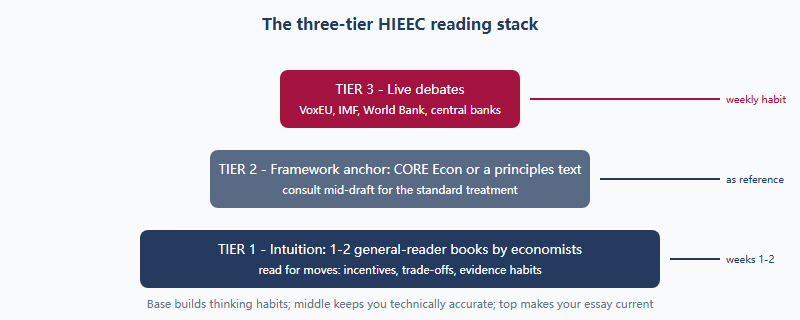
Read in three tiers before you draft: one accessible book that teaches how economists think, one principles-level framework anchor you can consult while writing, and a steady diet of live policy analysis where real economic debates happen. A 1,500-word HIEEC essay leaves no room to fake depth — and depth is built in the reading weeks before the prompt is even released, not during deadline month. Here is the roadmap, with an active note system to make the reading pay off on the page.
Why reading depth decides HIEEC essays
HIEEC — run by HUEA, the Harvard Undergraduate Economics Association (a student organisation, not Harvard University itself), with the Harvard College Economics Review — caps essays at a strict 1,500 words across one of four released prompts. That cap changes what reading is for. In a long research paper, thin understanding can hide behind length; in 1,500 words, every paragraph either carries a well-digested idea or visibly pads. Judges reading many entries on the same four prompts see the same surface-level talking points repeatedly. What stands out is the essay whose author has clearly read beyond the first page of search results — a different mechanism explained clearly, an example the other entrants did not reach, a counterargument taken seriously because the writer actually understands the opposing school of thought.
This roadmap is about building intellectual capital, which is a different job from finding statistics to cite once your argument exists. Think of it as three tiers, each answering a different question: how do economists think, what is the standard framework, and what are they arguing about right now. (If you have not yet read the contest basics — four prompts, Chicago/APA referencing, entry fee, early-January-pattern deadline — start with our complete HIEEC guide.)
Tier 1: intuition — learn how economists see the world
Start with one or two books written for general readers by serious economists. Their job is not to teach you curves; it is to install the habits of thought — incentives, trade-offs, unintended consequences, the difference between what a policy intends and what it does — that make an essay read like economics rather than opinion journalism. Widely used starting points include:
- Tim Harford, The Undercover Economist — everyday phenomena explained through core micro logic; excellent for learning to apply models to ordinary situations.
- Ha-Joon Chang, Economics: The User's Guide — a tour of the discipline that takes rival schools of thought seriously; useful ballast against one-model-fits-all essays.
- Abhijit Banerjee & Esther Duflo, Good Economics for Hard Times — two Nobel laureates walking through immigration, trade, growth and climate with evidence-first reasoning; a masterclass in the claim-evidence-caveat rhythm strong essays use.
One or two of these, read attentively, beats five skimmed. You are reading for moves, not facts: notice how the author sets up a question, which evidence they treat as decisive, and where they concede uncertainty.
Tier 2: one framework anchor you can consult while writing
Intuition without structure produces essays that gesture at economics without doing any. You need one principles-level reference where you can look up the standard treatment of a topic mid-draft — externalities, price controls, exchange-rate regimes — and get the mainstream framing right before you critique or extend it.
- CORE Econ, The Economy — a complete, free, online introductory text built around real-world problems (inequality, environment, innovation). For self-studiers this is the single highest-value resource on this page, and its real-data orientation matches essay writing better than exam-oriented texts.
- Any standard principles textbook (Mankiw's Principles of Economics is the common example) — if your school library has one, it does the same anchoring job; read it as a reference, not cover to cover.
Students already taking IB, AP or A-Level economics can usually treat their course text as this anchor and spend the saved time on Tiers 1 and 3. The anchor's role in your final essay is quality control: before you build an argument on a concept, check you are using it the way economists actually use it. Misused terminology is one of the fastest credibility killers in a competition essay.
Tier 3: living economics — where the current debates are
The top tier is periodical reading, and it is what most visibly separates entries. Prompts in essay competitions tend to touch live questions, and the entrant who has followed the actual debate writes with a currency that textbook-only preparation cannot fake. Build a light weekly rotation from sources like:
- VoxEU (CEPR) — short columns by academic economists summarising their research for a policy audience; the closest thing to citable frontier thinking written at a readable level.
- IMF Finance & Development and the IMF Blog — accessible treatments of macro, trade and development questions with data attached.
- World Bank blogs and reports — strong on development topics and rich in country-level examples beyond the usual US/EU cases.
- Central bank speeches and bulletins (Federal Reserve, ECB, Bank of England, People's Bank of China releases) — primary-source windows into how policymakers themselves frame trade-offs.
- A quality newspaper's economics coverage — for breadth and for noticing which stories keep recurring.
Thirty to forty-five minutes twice a week is enough. The goal is not coverage; it is that by prompt-release day you already know which live debates you find genuinely interesting — which feeds directly into choosing the prompt that plays to your strengths.
Read actively: the argument-bank note system
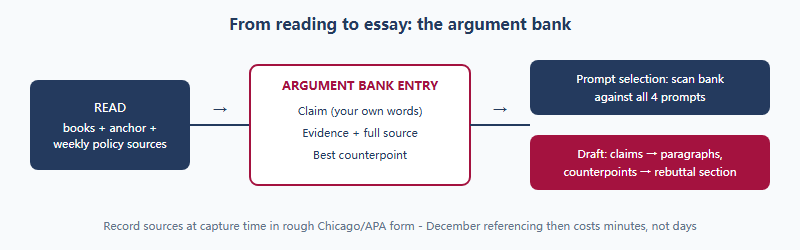
Reading without capture is entertainment. The bridge from reading to essay is a simple three-field note — we call it an argument bank — kept in one file:
- Claim: one sentence stating the idea in your own words (“congestion pricing works but is politically fragile because costs are visible and benefits diffuse”).
- Evidence: the example, episode or statistic attached to it, with the full source recorded immediately — author, title, publication, date, URL — in rough Chicago or APA form so citation costs you nothing later.
- Counterpoint: the best objection you can think of, or the one the author concedes.
Twenty such entries, accumulated over a summer, is a formidable asset. When prompts are released, you scan the bank against each prompt and immediately see where you have material — often the deciding input in prompt selection. And when you draft, the counterpoint field becomes your counterargument section, which is where our guide to structuring the 1,500-word essay shows most entrants are thinnest.
A six-week schedule that fits around school
Here is the roadmap as a schedule, sized for roughly three to four hours a week. Started in summer it is comfortable; started in autumn it compresses to four weeks by trimming Tier 1 to one book.
| Week | Reading | Argument-bank output |
|---|---|---|
| 1 | Tier 1 book, first half | 3 entries |
| 2 | Tier 1 book, second half | 3 entries |
| 3 | CORE Econ / principles text: 2 units on topics you found interesting | 2 entries + corrected definitions for earlier notes |
| 4 | Begin Tier 3 rotation: 3 VoxEU columns + 1 IMF or World Bank piece | 4 entries |
| 5 | Tier 3 rotation + 1 central bank speech | 4 entries |
| 6 | Tier 3 rotation + reread your whole bank | 4 entries + shortlist of 3 topics you could argue about today |
FAQ
How many books do I need to read for HIEEC?
One or two Tier 1 books read actively, plus a framework reference you consult rather than finish. Beyond that, weekly policy reading beats additional books.
Is this the same as gathering data for my essay?
No. This roadmap builds background understanding before prompts exist. Targeted evidence-gathering for your chosen prompt is a separate, later step once the questions are released.
Can I cite Tier 1 popular books in the essay itself?
Sparingly. They are credible for ideas and framing, but for empirical claims judges expect primary or institutional sources. Use the books to think, institutions and research to cite.
I only have four weeks — what do I cut?
Cut to one Tier 1 book and skip Tier 2 reading (keep it as a lookup reference only). Never cut Tier 3: recent, real-world engagement is the hardest thing to fake in a 1,500-word essay.
This is an independent guide operated by Hanlin Education for China-based international-school students. It is not affiliated with, endorsed by, or sponsored by HUEA, the Harvard College Economics Review, or Harvard University. Reading suggestions are editorial recommendations only; competition details change by cycle — always confirm current rules, dates and fees on thehuea.org. Errors brought to our attention are corrected within 7 working days.