If you already have an IB Extended Essay, an Economics internal assessment, an AP Research paper or a long school essay in economics, you are not starting HIEEC from zero. But you cannot cut a school paper down to 1,500 words either. The two documents answer to different readers and different contracts. This is the rebuild — four gates, one word budget, five moves.
Why cutting down does not work
A school research paper is assessed on process. Your reader is contractually obliged to finish it, and much of the mark sits in visible scaffolding: a stated research question, a defensible method, engagement with sources, an honest evaluation section. Length exists so that you can show the working. An IB Extended Essay caps at 4,000 words and an Economics commentary at roughly 800; an AP Research paper runs to several thousand words plus an oral defence — confirm the current specification with your DP coordinator or AP teacher, since those requirements are set by the IB and the College Board, not by us.
HIEEC is a different contract. The verified format is 1,500 words, strictly applied, with anything past the limit truncated; that limit excludes references, footnotes, titles, headers and footers. You answer one of four set prompts, reference in Chicago or APA, and submit a PDF. Judging runs in two tiers — the HUEA board reads the field, and the top ten are adjudicated by a Harvard economics professor. The 2025-26 cycle capped submissions at 600 and closed in early January; confirm the current cycle’s dates, fees and cap on thehuea.org. Our overview of what HIEEC is covers the rest of the format.
The consequence is structural, not stylistic. In a contest essay your reader is not obliged to finish and is comparing you against hundreds of other entries. Everything that makes an EE credible as coursework — the methodology section, the literature survey, the reflective evaluation — is precisely what has no room. Cutting an EE produces a compressed EE, which is a bad contest essay. You have to rebuild.
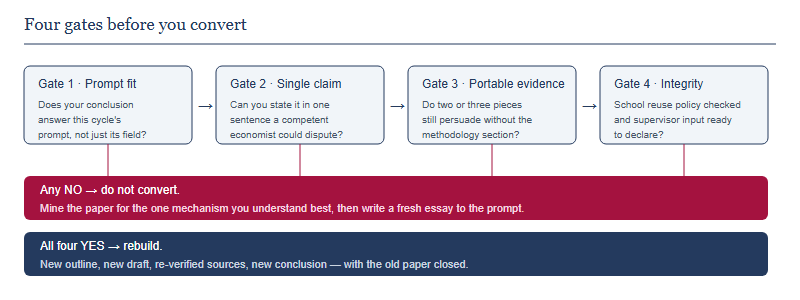
Gate 1: does your topic actually fit a prompt?
This is where most conversions fail, and it fails before you write a word. HIEEC sets four prompts and you answer one of them. The topic areas can differ from cycle to cycle — the 2025-26 set ranged across environmental, inequality, workforce-and-education and finance-technology territory — so read the current cycle’s wording on thehuea.org rather than assuming last year’s areas repeat. Never write to a remembered prompt.
Then apply the fit test honestly. There are three levels:
- Direct answer. Your EE’s conclusion, restated in one sentence, is a genuine answer to the prompt’s question. Convert.
- Adjacent. Your EE sits in the prompt’s field and gives you real expertise, but its conclusion answers a different question. You can convert only if you are willing to formulate a new question and let the old conclusion go.
- Same field only. Your EE and the prompt share vocabulary — “carbon”, “labour market”, “inequality” — and nothing else. Do not convert. A judge reads a keyword-matched essay as an essay that was not written for the prompt, because it wasn’t.
If two prompts look plausible, use the same selection logic you would use from scratch: our guide to choosing a prompt by strength applies unchanged. Having existing research is a tiebreaker, not an override.
The word budget: what survives the conversion
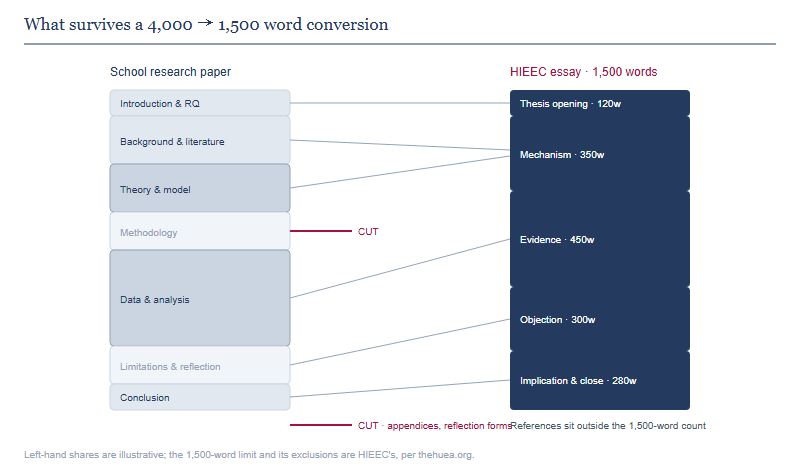
Before you touch the file, decide what the 1,500 words are for. The table below maps a typical long school paper onto a contest essay. The percentage column is illustrative — your own paper will differ — but the fate column is where the discipline lives.
| Section in a long school paper | Typical share (illustrative) | Fate in a 1,500-word HIEEC essay | Why |
|---|---|---|---|
| Introduction and research question | 8% | Becomes a thesis-first opening, roughly 120 words | The contest reader needs your claim, not your route to it |
| Background and literature | 15% | One framing sentence plus citations | You are not being assessed on source engagement |
| Theory and model | 15% | Keep — but one model applied, not a survey | Applied theory is the highest-value content you own |
| Methodology | 12% | Almost entirely cut | No marks exist here; the reader wants the finding |
| Data and analysis | 30% | Keep the two or three strongest pieces only | Evidence density beats evidence volume at 1,500 words |
| Limitations and reflection | 12% | Rewrite as one objection paragraph plus one honest limit | A contest wants the strongest counter-claim met, not a caveat list |
| Conclusion | 8% | Written new, answering the prompt | Your EE conclusion answers your EE question |
| Appendices, reflection forms | — | Out entirely | Not part of the submission format |
| References | — | Kept, re-styled in Chicago or APA | Required, and excluded from the 1,500-word count |
The rebuild in five moves
Move 1 — extract the single claim. Write one sentence that is arguable, specific and answers the prompt. Arguable means a competent economist could disagree with it. If your sentence contains “explores”, “investigates” or “analyses”, you have written a topic, not a claim. This sentence is the whole essay; everything else exists to defend it.
Move 2 — rebuild the outline from blank paper. Not from the EE’s contents page. Use the five-block budget in the diagram above: thesis, mechanism, evidence, objection, implication. Assign the word counts before you write, because at 1,500 words the allocation is the argument. Our guide to structuring the 1,500-word essay goes block by block.
Move 3 — re-draft; do not paste. This is the move people skip and the one that decides quality. If you paste EE paragraphs and edit them down, you import the EE’s register — hedged, procedural, written for an examiner who must keep reading. Close the old document. Write from your outline with the EE beside you as a source, not as a draft. You will be surprised how much you can reproduce from memory, and what you cannot reproduce was probably padding.
Move 4 — re-verify every carried-over source. Reopen each one. Confirm the number still says what you claimed a year ago, check whether the dataset has been revised, note the access date, and re-cite in Chicago or APA. Statistics get restated; a figure that was current when you wrote the EE may not be current now. Carrying an unchecked citation into a competition that treats plagiarism as grounds for disqualification is a risk you take for no benefit.
Move 5 — re-run the objection. An EE limitations section lists the weaknesses of your study — small sample, restricted period, proxy variable. A contest objection paragraph meets the strongest argument against your claim. These are different intellectual acts and the first cannot be edited into the second. Ask what a well-informed opponent would say, state it in its strongest form, and answer it.
The integrity check nobody does
Two rule sets apply and only one is HIEEC’s. On the competition side, the verified requirements are that the essay be written only by the entrant, that any outside assistance be declared at the beginning or end, and that plagiarism leads to disqualification. Those rules address assistance and originality. They are not the authority on whether your school, the IB or the College Board permits you to reuse work you submitted for assessment.
So do both checks before you invest the time:
- Ask your school. Your DP coordinator, AP teacher or head of department can tell you the policy on reusing assessed work. Ask in writing and keep the answer.
- Confirm the competition side on thehuea.org for the current cycle.
- Declare supervisor input. If your EE supervisor shaped the argument you are carrying across, that shaping is outside assistance and belongs in your declaration — one specific sentence at the start or end of the essay.
The practical risk runs in an unexpected direction. Even where the contest side is untroubled, overlapping submissions can raise questions at the school end, and those questions are much easier to answer before you submit than afterwards. A five-minute conversation now is the cheapest insurance in this process.
When not to convert
Some papers should stay where they are. Walk away if any of these describe yours:
- The value is in the method. If your EE’s contribution is a careful survey design or a regression you ran yourself, and the finding is modest, you lose the contribution and keep the modest finding. That trade is bad.
- The conclusion is descriptive. “This essay found that several factors influence X” cannot become an arguable claim without new thinking, so you are writing a new essay anyway.
- The evidence cannot travel. Interview data, school-collected surveys or a proprietary dataset that a reader cannot check will read as unverifiable in a contest where the reader has no time to take anything on trust.
- The fit is lexical. Shared keywords are not shared questions.
The alternative is better than it sounds. Keep the reading and drop the paper: extract the single mechanism you now understand more deeply than your peers, and build a fresh 1,500-word essay around it. You still have the advantage — months of accumulated understanding — without dragging the wrong document behind you. That is usually the stronger entry, and it is always the faster one to write.
Frequently asked questions
Can I submit my Extended Essay to HIEEC?
Not as it stands — the limit is 1,500 words, strictly applied. Rebuild it, and check your school’s policy on reusing assessed work first.
Do references count toward the 1,500 words?
No. The published limit excludes references, footnotes, titles, headers and footers. Confirm the current cycle’s rules on thehuea.org.
I am in Grade 10 with no Extended Essay yet — am I behind?
No. Entry is open across grades 9-12 per the rules we could verify, and a class essay converts using exactly the same four gates.
Should I mention that the essay grew out of my EE?
If your supervisor shaped the argument, declare that assistance at the beginning or end of the essay, as the rules require.
This is an independent guide operated by Hanlin Education for China-based international-school students. We are not affiliated with, endorsed by, or sponsored by HUEA, the Harvard College Economics Review, or Harvard University. Extended Essay and AP Research requirements are set by the IB and the College Board respectively; confirm current HIEEC details on thehuea.org before you enter. Factual errors reported to our editorial desk are corrected within 7 working days.