A trade prompt is rarely asking whether trade is good. It is asking who gains, who loses, and through which channel — and whether a specific policy fixes a named failure or just moves the loss somewhere less visible. Essays that argue for or against globalisation read like op-eds. Essays that trace incidence read like economics. This is the toolkit for the second kind.
What a trade prompt is asking — and the four models that answer it
Trade, tariffs and industrial policy recur as themes in third-party summaries of past HIEEC cycles, but we could not verify any prompt list against a primary source, and the official page does not state how many prompts the coming cycle will carry or what they will say. Prompt wording is set by the organisers and released in the autumn, and the past-year attributions circulating on guide sites are not verifiable — treat any question you see quoted as unconfirmed and check the live set on thehuea.org when it appears. What you can prepare now is the shape of the question, because the shape is stable even when the wording is not.
Questions in this area almost always reduce to one of three forms, and diagnosing yours is the highest-value hour of the whole project.
- The distribution form. Trade or a trade shock has happened — who inside the country gained and who lost? Centre of gravity: factor incomes, regional concentration, adjustment costs.
- The protection form. A barrier is proposed or in place — what does it actually do? Centre of gravity: incidence, retaliation, downstream costs.
- The industrial-policy form. A state wants to build or protect a sector — can it, and should it? Centre of gravity: the market failure being claimed, and government capability.
The verb usually gives it away. “Assess the effects of” is the distribution form. “Should country X impose” is the protection form. “Can policy build” or anything mentioning strategic sectors is the industrial-policy form. A 1,500-word essay answers one of these properly or three of them badly. Our guide to choosing a prompt by strength covers how to make the call before you sink reading time into the wrong one.
You do not need a trade course. You need four ideas you can deploy accurately and defend under questioning. Everything else in the field is a refinement of these.
| Model | What it explains | What it cannot do | Use it when the prompt says |
|---|---|---|---|
| Comparative advantage | Why two countries both gain from specialising, even when one is better at everything | Say anything about who inside each country gains; it is a statement about aggregates | “Is trade mutually beneficial”, “why does country X export Y” |
| Factor returns and distribution | Why opening to trade raises the return to a country's abundant factor and lowers it for the scarce one | Predict the speed of adjustment, or where displaced workers actually go | “Winners and losers”, “inequality”, “regional decline” |
| Tariff incidence | Who bears the cost of a barrier, and why that is an elasticity question rather than a legal one | Tell you the size of any effect without data | “Should a tariff be imposed”, “who pays”, “protect domestic industry” |
| Market failure plus learning effects | The only respectable case for supporting a sector: an externality, a coordination problem or a capital-market gap | Justify support on the grounds that a sector is important, large or patriotic | “Industrial policy”, “strategic industries”, “subsidies”, “semiconductors” |
The most common structural mistake is reaching for comparative advantage in a distribution question. Comparative advantage says the national pie grows. The prompt is usually asking about the slices. Answering with the pie is technically correct and rhetorically useless, and a reader who knows the field registers it immediately as a student reciting the first thing they learned.
Tariff incidence: the mechanism most drafts get wrong
If your prompt involves a barrier, incidence is where your marks live. A tariff is a legal obligation on an importer. It is not a statement about who ends up poorer. Who ends up poorer depends on how easily each side can walk away, and an essay that establishes this — carefully, in about 200 words — is already ahead of most of the drafts we edit.
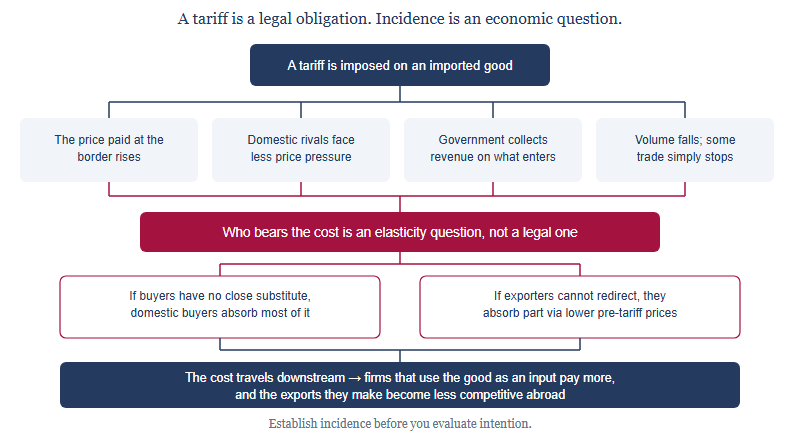
Two refinements will lift the section further. First, downstream exposure: a tariff on an intermediate good is a tax on every domestic firm that uses it, including exporters, which is why protection can reduce a country's export competitiveness. Second, retaliation: barriers rarely stay unilateral, and an essay that models a one-sided move as if the other party is a rock rather than a player has assumed away the interesting part.
Industrial policy: three tests that separate an argument from a slogan
Industrial policy is the most rewarding and most abused area in this category. Almost every weak essay defends support for a sector on the grounds that the sector is important. Importance is not an economic argument; it is a description. Run any industrial-policy claim through three tests and write the answers, in order.
- The failure test. Name the specific market failure. Is it a learning spillover firms cannot capture? A coordination problem where no one moves first? A capital market that will not fund long-horizon risk? If you cannot name it, you do not have a case — you have a preference.
- The capability test. Does the state have the information to pick correctly, and the political ability to stop when it is wrong? A policy that is right in theory and undeliverable in practice is a proposal, not an answer.
- The exit test. What observable measure would tell you, in five years, that this failed — and what happens then? Support with no stopping rule becomes permanent, and permanent support has a name in the literature that is not flattering.
An essay that runs these three tests honestly can reach either conclusion and still score. That is worth internalising: the graders are not scoring your position. They are scoring whether the position survived contact with its own strongest objection.
Evidence, and where the 1,500 words go
Trade is unusually well served by public data, which removes any excuse for vague quantities. Go to primary sources and cite them with dates, because trade figures are revised and a stale number quoted confidently is a visible tell.
- WTO — tariff profiles, dispute records and the legal architecture behind any barrier you discuss.
- UN Comtrade and the World Bank's WITS — bilateral flows by product, the right tool when you need “how much of X does A actually send to B”.
- OECD — trade in value added, which is the only sensible way to talk about supply chains, because gross export figures double-count components crossing borders repeatedly.
- UNCTAD — investment flows and developing-economy trade, useful for the industrial-policy form.
- National statistics and customs agencies — the underlying series, and the place to check when a headline figure looks too neat.
The value-added point deserves emphasis because it is the single most underused idea available to a China-based writer. A phone assembled in one country from components made in five others shows up in gross trade statistics as a large export from the assembler. Value-added data shows where the income actually accrued. An essay that notices this distinction, and applies it to a real product, has an analytical move that few of the drafts we edit manage.
With the sources settled, the remaining question is proportion. A trade essay fails most often not because the writer lacked evidence but because background and description ate the space that the mechanism and the objection needed. The allocation below is the one we use when editing drafts back into length.
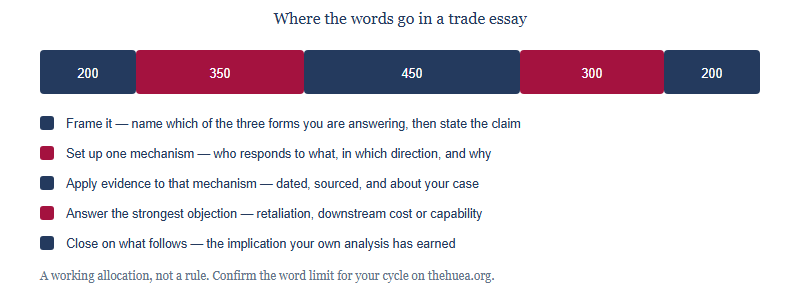
Notice how little goes to background. Trade prompts tempt students into a history lesson — the origins of a dispute, a chronology of measures — and history consumes words without producing analysis. If a fact does not feed the mechanism, it is decoration. Our structure and method guide for the 1,500-word essay goes through the section-by-section discipline in more detail.
Three traps we see in China-based drafts
Editing trade essays from students in Chinese international schools, the same three failures recur. They are worth naming because each one comes from a real advantage being used badly.
- The scale substitute. “China is the world's largest exporter of X, therefore…” Size is a fact, not a mechanism. The sentence after the statistic has to say what the size does — market power in setting prices, a coordination advantage in components, exposure to a single buyer. Without that sentence the number is filler.
- Deficit as defeat. Treating a bilateral trade deficit as a loss, or a surplus as a win. A bilateral balance is an accounting residual between two countries in a multilateral system; it is not a scoreboard. Getting this right is a cheap way to signal that you have read past the headlines.
- The family-firm anecdote. Local knowledge is genuinely valuable, and a supplier your family knows can be a real observation. But one firm is an illustration, not evidence. Use it to make a mechanism concrete after you have established the mechanism with data — never to establish it.
The underlying discipline is the same in all three: a home-market observation earns its place only when it is doing analytical work that a reader in Cambridge could not have supplied themselves. If you are new to the contest and want the structural overview first, start with our complete guide to what HIEEC is, then come back to this once you have a prompt in hand.
Frequently asked questions
Will there be a trade prompt in the 2026-27 cycle?
Unknown. The prompt set is released by the organisers each autumn and the count for this cycle is not yet stated. Confirm the live set on thehuea.org.
Do I need to have studied international trade?
No. Four ideas — comparative advantage, factor returns, tariff incidence and market failure — carry almost every question in this category.
Can I argue in favour of tariffs?
Yes. Either direction scores if you establish incidence honestly and answer the strongest objection rather than the easiest one.
How much space should background take?
Very little. If a historical fact does not feed the mechanism you are testing, it is spending words your objection section needs.
This is an independent guide operated by Hanlin Education for China-based international-school students. We are not affiliated with, endorsed by, or sponsored by the Harvard Undergraduate Economics Association, the Harvard College Economics Review, or Harvard University. Prompt areas, wording, word limits, fees and rules are set by the organisers and change each cycle — confirm current details on thehuea.org. Nothing here is investment advice. Factual corrections are made within 7 working days.