Workforce & Education is one of the four labels HUEA gave its prompts in both of the last two published cycles, and both versions asked the same thing underneath: when technology changes what work requires or where it happens, who adjusts, and what should policy do? Strong essays pick one mechanism, one affected group and one lever. Weak ones forecast the future of work.
What this category has actually asked, from HUEA’s own pages
Prompt wording quoted on third-party sites is hard to trace to any source. For this category there is a better one. HUEA lists the full prompt set for each of its last four cycles on its own results pages, and the two most recent sets carry category labels. When we read the 2024-25 and 2025-26 results pages in September 2026, the third prompt in each was labelled Workforce & Education. The unlabelled 2023-24 set included a prompt on artificial intelligence and the workforce, which belongs to the same family.
| Cycle | What the prompt asked (our paraphrase) | The economic question underneath | Where the weight usually belongs |
|---|---|---|---|
| 2023-24 no label |
How AI will affect inequality, the make-up of the workforce and total output, and how nations can prepare | Which tasks does the technology replace, and which does it make more valuable? | The mechanism, before any forecast |
| 2024-25 Workforce & Education |
How education systems should adapt to automation and AI, the economic impact of emphasising STEM versus soft skills and critical thinking, and which policy and institutional changes would build a resilient workforce | How do the returns to different skills change when machines change the mix of tasks? | The skills comparison, argued for a defined group of students |
| 2025-26 Workforce & Education |
The long-run implications of a shift to remote and hybrid work for productivity, urban inequality and educational priorities, and the role of governments and institutions in balancing flexibility against labour-market fragmentation | When being near an office matters less, who loses the spending, jobs and tax revenue that proximity used to support? | One item from that list, followed to its distributional end |
Two cautions. First, a label used twice is a pattern, not a promise: HUEA’s competition page says the 2026-27 rules and prompts will be posted when the contest opens this autumn, gives October–November for prompt release, and marks every date as tentative. Prepare for a family of questions, not a wording. Second, both labelled versions bundled several asks into one prompt (the 2025-26 version lists three effects to consider), and an essay that gives each part equal space ends up thin on all of them.
The only published winning essay from a labelled Workforce & Education prompt shows the alternative. Of the three winning essays HUEA posted for 2025-26, one answered the remote-work prompt under the title System Migration: Retaining Residents in a Remote Revolution. As we read it, the essay took one country as its main reference point, spent most of its length on who loses when remote workers leave large cities, argued about what cities could do to draw them back, and built a small tabulation of its own from a public government survey. Productivity received a paragraph. Education appeared as a policy lever rather than as a section of its own.
Three mechanisms that carry almost every version of the question
You do not need a labour economics course for this category. You need three mechanisms you can use precisely, each with a literature you can cite by name rather than by headline.
| Mechanism | What it explains | What it cannot tell you | Where to start reading |
|---|---|---|---|
| Task-based change | Technology takes over particular tasks and makes others more valuable, so effects land on specific work rather than on whole occupations | Whether new tasks appear fast enough to absorb the people displaced | Autor, Levy and Murnane (2003) on the task content of jobs; Acemoglu and Restrepo (2019) on displacement and new tasks |
| Returns to skills | Why the value of an education shifts when the task mix shifts, and why a credential can pay even when its content does not | Which skill is “better”, until you state a group, an outcome and a time horizon | Goldin and Katz, The Race between Education and Technology (2008); Becker (1964) on human capital; Spence (1973) on signalling |
| Proximity | Why cities pay more, and what happens to local services, rents and tax revenue when fewer people need to be near an office | How much work will stay remote, which is still moving | Althoff, Eckert, Ganapati and Walsh (2022) on the geography of remote work; Ramani and Bloom (2021) on the “donut effect” |
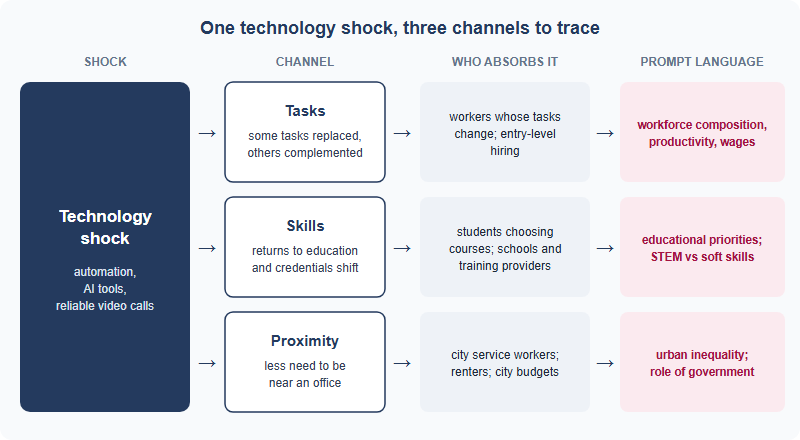
The commonest structural error in this category is reaching for the wrong mechanism. An education prompt is asking, underneath, about the returns to skills; answering it with a forecast of which jobs will vanish describes the shock and never explains the response. A remote-work prompt is asking, underneath, about proximity; answering it from the worker’s point of view, with shorter commutes and more flexibility, describes the first-order gain and misses the second-order losers — usually the people whose incomes depended on office workers being nearby.
The education version: STEM versus soft skills needs a margin
The 2024-25 prompt framed a comparison, and a comparison without a margin cannot be settled. Put in our own words rather than HUEA’s, “Should schools emphasise STEM or soft skills?” has no answer. “For a student choosing between one more quantitative course and one more course built on discussion and writing, which does more for earnings over the first decade of work, given how automation is changing entry-level tasks?” has an answer you can argue. Three decisions turn the first question into the second.
- Which group. The student choosing between two courses, the school deciding what to require, or the adult worker retraining. Each faces different costs and generates different evidence.
- Which outcome. Earnings, the chance of employment, or resilience when the next technology arrives. They do not always move together.
- Which theory of schooling. If education mainly builds productive skill, changing its content changes outcomes. If it mainly signals ability to employers, reorienting the curriculum changes less than it appears, and the credential race simply moves to a new subject. Saying which view you take, and why, is most of an argument.
The most useful empirical handle is the difference between complements and substitutes. Skills that machines complement gain value; skills they substitute for lose it. That line cuts across the STEM label rather than along it: routine calculation is exposed, while formulating a problem and persuading others to act on the answer are not. Deming (2017) documents the rising labour-market value of social skills and their growing complementarity with quantitative ones, which is exactly why a well-built essay rarely concludes “STEM” or “soft skills” outright.
For the institutional part of the question, be concrete about levers: what exams reward, which courses count for progression, how vocational routes are recognised, and who pays for adult retraining. Students at China-based international schools often know an assessment-driven system from the inside, and that is genuine evidence of how incentives shape what gets taught. Argue it as incentives, with assessment acting as the price signal of a school system, rather than as a complaint about pressure.
The remote-work version: follow the spending and the tax base, not the commute
The first-order effects of remote work, on workers and firms, are the easier half, and the evidence depends heavily on the arrangement: fully remote and hybrid work are different treatments, and an essay that averages them has already lost precision. China-based writers have an unusual home-market advantage here. Two of the best-known randomised trials of working from home were run at Trip.com, formerly Ctrip, a Chinese travel company — Bloom, Liang, Roberts and Ying (2015) on call-centre staff, and Bloom, Han and Liang (2024) on hybrid schedules for office employees. Cite the design as well as the result, because a trial inside one firm speaks first to that setting.
The second-order effects are where this prompt keeps its marks, and they run through three channels.
- Who can work remotely. The ability to work from home is concentrated in higher-paid, more highly educated occupations, so the shift is itself a channel of inequality before any policy responds. Official time-use and labour-force surveys let you show this rather than assert it.
- Who depended on proximity. Office workers buy lunches, haircuts and transport near their offices. When they stay home, the loss lands on consumer-service workers in central districts, which is the distributional core of the question.
- What happens to city finances. Lower demand for central office space and shifting residential demand move property values and tax bases, and some places gain what others lose.
That last channel is the one most drafts miss when they reach the role of government. Gains and losses from remote work are divided by geography, so “the government” is not one actor. A national measure that props up central business districts can pull activity from the suburbs and smaller cities that gained it, while a city acting alone controls only its own levers: zoning, amenities, services and local taxes. Name the level of government before the policy, and the trade-off between flexibility and fragmentation becomes something you can argue.
Evidence and traps: exposure is not impact
This category attracts confident numbers of weak provenance. Headlines about the share of jobs “at risk” are everywhere, and most are exposure estimates: calculations of which occupations contain tasks a technology could perform. Exposure tells you where effects might fall. It does not tell you whether they have, or which way wages moved. Keep the two apart, and rank what you cite.
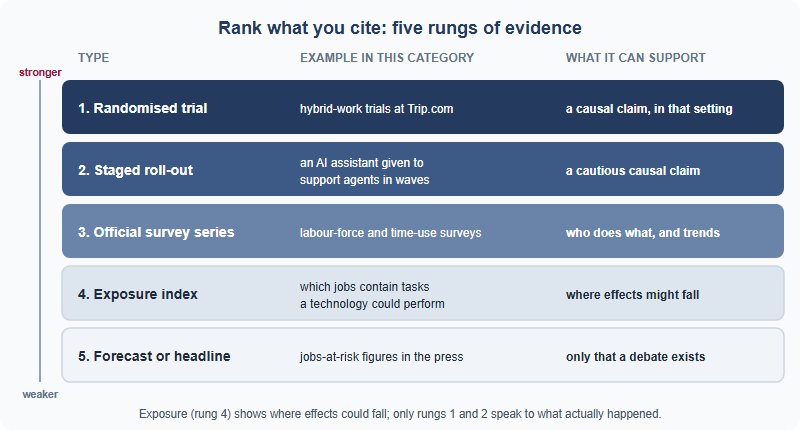
Useful sources, by rung: peer-reviewed trials and natural experiments for causal claims, such as the Trip.com studies or Brynjolfsson, Li and Raymond’s study of an AI assistant introduced to customer-support agents in stages; official series — national labour-force and time-use surveys, the OECD’s Survey of Adult Skills, China’s National Bureau of Statistics — for who does what; and the ILO’s occupational exposure studies for where generative AI could reach. Date every figure. Remote-work shares and AI adoption have moved quickly since 2020, and a three-year-old number quoted as current is visible to an expert reader.
Three traps recur in the China-based drafts we edit:
- The forecast essay. It opens with a prediction about how many jobs AI will replace by a given year and never states a mechanism. Replace the prediction with a task-level claim: which tasks, for which workers, in which direction.
- The exam-culture essay. An education prompt turns into a critique of pressure and memorisation. The frustration may be real, but without returns, incentives and a defined margin it does not answer an economics question.
- The commuter’s-eye essay. A remote-work prompt turns into a list of benefits for people who can work from home. The prompt asks about inequality and cities, and the people it is asking about mostly cannot work from home at all.
Still deciding whether this category suits you? Our guide to choosing a prompt by strength rather than topic appeal comes first, and our walkthrough of building the argument inside roughly 1,500 words covers what follows. For eligibility, judging and recognition, start with our overview of HIEEC.
Frequently asked questions
Will the 2026-27 contest have a Workforce and Education prompt?
Nobody knows yet. HUEA used that label in 2024-25 and 2025-26, and its page lists October to November as the tentative prompt window.
Do I have to cover both the labour market and education?
Read the live wording first. Past versions listed several items, so carry one channel in depth and treat the others briefly but explicitly.
Can I use China as my main example?
Yes, if the data supports it. Two of the best-known randomised trials of working from home were run at Trip.com, a Chinese company.
Are forecasts of jobs lost to AI good evidence?
They measure exposure, not impact. Use them to show where effects might fall, then support your claim with measured outcomes.
This is an independent guide operated by Hanlin Education for China-based international-school students. We are not affiliated with, endorsed by, or sponsored by HUEA (the Harvard Undergraduate Economics Association), the Harvard College Economics Review, or Harvard University. Past prompts are paraphrased from HUEA’s published results pages; 2026-27 prompts, word limits, deadlines and rules are set by the organisers and have not yet been released — confirm current details on thehuea.org. Factual corrections are made within 7 working days.