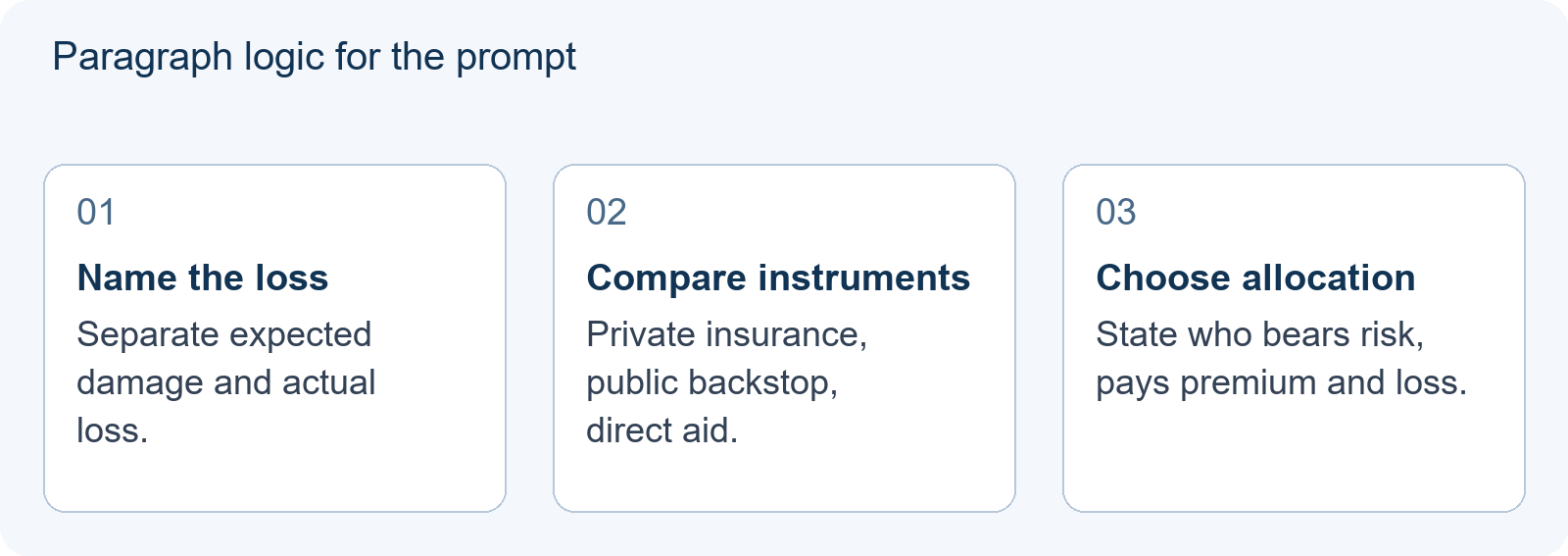
The 2026-27 HIEEC environment prompt is not a carbon-tax question. It asks who should bear the cost when private insurers withdraw from wildfire- and storm-prone housing markets, when government-backed schemes hold down premiums, and when many homes have no insurance at all. A strong answer works at three levels: who bears risk before a disaster, who pays premiums, and who pays after loss. It then compares private insurance, public backstops and direct compensation on efficiency and equity, rather than declaring that ‘society’ should pay.
Read the source prompt before choosing a theory
Environment
Insurers have pulled back from wildfire- and storm-prone parts of California and Florida, and Australia and the UK run government-backed schemes that hold down premiums in cyclone and flood zones; in many other countries, few homes are insured at all. As climate risks grow, who should pay for damage to homes in the most dangerous places?
Source note: the Environment prompt above is reproduced from Hanlin Courses’ 2026-27 HIEEC prompt announcement (WeChat, 28 October 2026). That report also gives the deadline as 11:59 p.m. US Eastern Time on 5 January 2027; a 1,500-word limit including footnotes but excluding references; and a single PDF no larger than 10MB, with no author or school name because review is anonymous. The report also lists shared instructions in Chinese. Because no authorized English source text was supplied, this guide does not reproduce or paraphrase those instructions; check the organizer’s English source text or file for exact wording before relying on them. Organizer reference: HUEA, whose public site identifies the 2026-27 contest as open. This independent guide is not affiliated with HUEA or the Harvard College Economics Review.
What the question is really asking
The prompt is about allocation under climate risk, not about whether climate change is real. It contains three separate decisions that students often merge:
- Risk bearing before loss: who holds the financial exposure to future wildfire, storm, cyclone or flood damage?
- Premium pricing: who pays how much each year for insurance, and whether premiums reflect expected loss or are held down by regulation or public subsidy.
- Post-disaster payment: when homes are damaged, who transfers money to owners, renters and local governments?
A good essay keeps these questions distinct. Insurance availability is not the same as affordability. A public backstop that lowers premiums is not the same as free protection. Direct compensation after a disaster is not the same as an insurance contract. The prompt’s reference to Australia and the UK is a clue that public risk-sharing already exists; its reference to countries where few homes are insured is a warning against treating the California or Florida market as the default case.
For the separate carbon-pricing and offsets angle, see Writing the Environment Topic: Carbon Pricing, Offsets and Climate Policy in 1,500 Words. That article covers a different mechanism. This prompt is about insurance retreat and residual risk.
The economics that separates analysis from a slogan
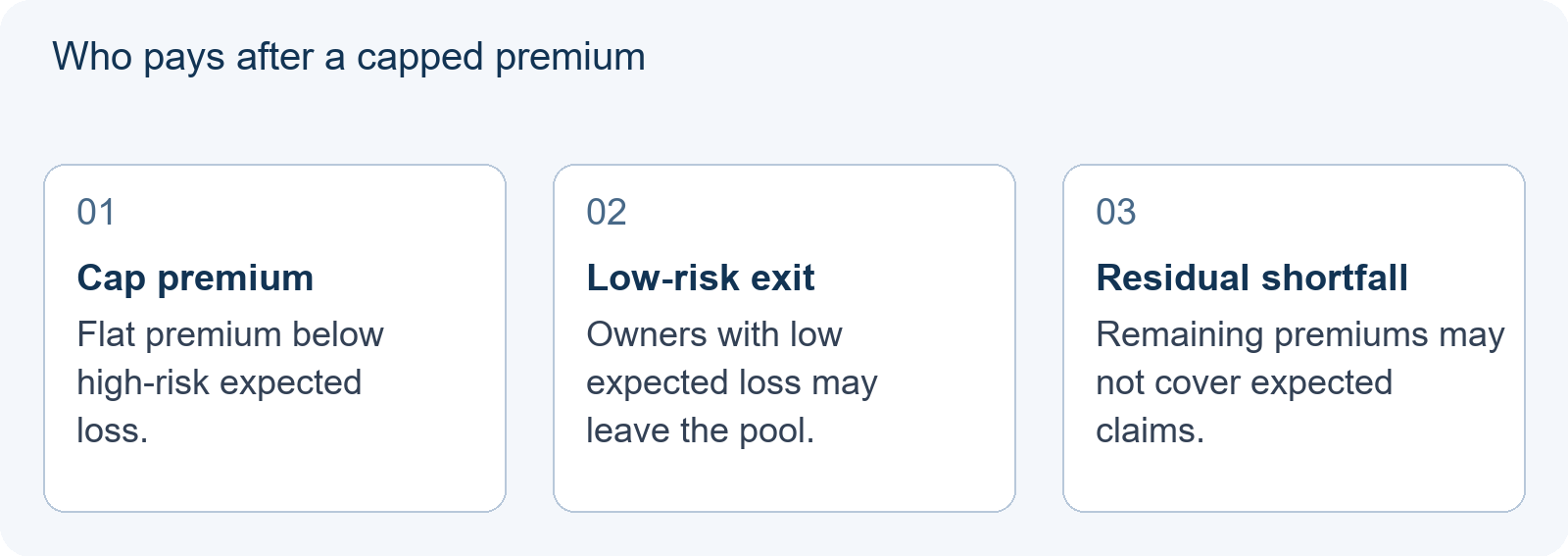
Adverse selection matters when participation is voluntary and premiums are not risk-based. If low-risk owners pay more than their expected loss, some will leave. The remaining pool becomes riskier, which can push premiums up again. A flat or capped premium can therefore be stable only if participation is broad, if public money covers the gap, or if the cap is combined with other rules.
Moral hazard matters because insurance changes incentives. If owners pay less than the expected cost of their risk, they may invest less in fire-resistant roofs, defensible space, elevation or drainage. This is not an argument that insured people are reckless. It is an argument that prices and contract conditions affect behaviour at the margin. Public backstops can create a related ‘charity hazard’: if taxpayers are expected to cover losses, private mitigation and private insurance may both shrink.
Risk pooling works best when risks are independent. Wildfire and storm losses can be correlated across many homes in one region, so private insurers need capital, reinsurance and diversification. A government can spread the cost across a wider tax base, but it cannot make the physical loss disappear. The real choice is whether the loss is paid by policyholders, homeowners, taxpayers, donors or future generations.
Equity needs a stated principle. ‘Ability to pay’ supports subsidies for low-income owners. ‘Beneficiary pays’ argues that people who choose to live in dangerous places should bear more of the cost. ‘Equal treatment of similar losses’ supports uniform compensation after a disaster. These principles can conflict, and a strong essay says which one it is using.
The useful discipline is to separate efficiency from fairness, as explained in HIEEC Welfare Analysis: Distinguishing Efficiency Gains From Fairness Claims. Then state the assumption that could reverse your conclusion, following HIEEC Economic Models: Writing the Assumption That Could Reverse Your Conclusion.
A teaching illustration: who pays when a premium is capped?
The following is a hypothetical teaching example, not contest data and not an estimate from any country. Suppose two regions each contain 100 owner-occupied homes. Region A has expected annual damage of $1,000 per home. Region B has expected annual damage of $10,000 per home because it faces greater wildfire or storm risk. Administrative costs, capital costs, reinsurance and investment income are ignored so the arithmetic is transparent.
| Region | Homes | Expected damage per home | Expected annual loss |
|---|---|---|---|
| A: lower risk | 100 | $1,000 | $100,000 |
| B: higher risk | 100 | $10,000 | $1,000,000 |
| Total | 200 | — | $1,100,000 |
With risk-based premiums, A would pay about $1,000 per home and B about $10,000 per home. Now suppose a regulator caps the premium at $6,000 per home. If all 200 homes remain insured, the insurer collects $1,200,000 against expected claims of $1,100,000. Region A pays $600,000 but has expected losses of only $100,000, so it overpays by $500,000. Region B pays $600,000 but has expected losses of $1,000,000, so it is undercharged by $400,000. The pool still has a $100,000 surplus before costs.
If low-risk owners in A can leave, the picture changes. At a $6,000 premium against $1,000 expected loss, many may exit. If only B remains, the insurer collects $600,000 from 100 homes but expects $1,000,000 of claims. The shortfall is $400,000. That gap must be covered by reserves, a government backstop, a levy on other policyholders or taxpayers, or by reducing claims payments. The cap did not remove the risk; it shifted who bears it.
This is why the essay should not stop at ‘make insurance affordable’. A cap can be good policy if the distributional gain is worth the efficiency cost and if the residual risk is explicitly assigned. It can be poor policy if it hides a growing public liability and weakens incentives to reduce risk.
Compare three instruments, not one villain
| Instrument | Efficiency question | Equity question | Main risk |
|---|---|---|---|
| Private risk-based insurance | Prices signal risk and encourage mitigation, but correlated catastrophes require capital and reinsurance. | High-risk owners may face unaffordable premiums even if they are not wealthy. | Insurer withdrawal and coverage gaps. |
| Public backstop or capped premium | Can keep coverage available and spread risk across taxpayers, but may weaken price signals. | Transfers cost to the public budget; the incidence depends on tax design. | Hidden fiscal liability and moral hazard. |
| Direct compensation after disaster | Can target urgent need and fill gaps where insurance markets are thin. | May treat similar losses similarly, but eligibility can be political. | Uncertainty, delay and weak ex ante incentives. |
The comparison should be explicit about who pays. A public backstop is not ‘free insurance’; it is insurance or compensation financed through taxes, levies or future borrowing. Direct compensation may be the only realistic route where few homes are insured, but it can be slow and politically discretionary. Private insurance can price risk, but it may retreat when losses are correlated and capital is costly.
What about places where few homes are insured?
The prompt deliberately widens the frame beyond California and Florida. In many countries, home insurance markets are shallow, so the practical policy menu is not a choice between two mature insurance schemes. It may be ex post government relief, donor support, reserve funds, community schemes or gradual expansion of insurance. Each option faces fiscal-capacity limits and verification problems. A strong essay should not assume that a rich-country backstop can be copied everywhere, and it should not treat uninsured households as irrational. They may face low incomes, unclear title, weak enforcement or a history of insurers refusing claims.
This is also where equity becomes concrete. If the most dangerous places are also poorer places, asking homeowners to pay actuarially fair premiums may be unaffordable. If they are wealthier coastal or hillside communities, public subsidy may be regressive. The essay should avoid assuming either pattern and should say what evidence would settle the question.
A 1,500-word plan that answers the question
- Answer first, about 100 words: state that responsibility should be split among risk-based insurance, a capped public backstop and targeted direct aid, with the split depending on affordability and mitigation incentives.
- Define the three allocations, about 150 words: risk bearing, premium pricing and post-loss payment. Explain why they are not interchangeable.
- Explain private retreat, about 220 words: correlated catastrophe risk, reinsurance, capital and adverse selection. Use one concrete country example from the prompt.
- Analyse public backstops, about 250 words: how a cap or government scheme lowers premiums, who pays the residual, and how it affects mitigation.
- Cover uninsured places, about 200 words: direct relief, fiscal capacity and the limits of transferring a rich-country model.
- Make the distributional trade-off visible, about 200 words: use a table or a small hypothetical calculation like the one above. Do not present it as empirical data.
- Answer the strongest objection, about 220 words: if you favour public payment, explain why moral hazard is acceptable or how conditions limit it. If you favour risk-based pricing, explain what happens to poor owners.
- Conclude with an allocation rule, about 160 words: who pays for what, under which conditions, and what would change your mind.
Diagnostic questions and common traps
Before drafting, test the plan against these questions:
- Does the essay distinguish insurance availability from premium affordability?
- Does it say who bears risk before the disaster, not only who pays after it?
- Does it separate efficiency arguments from fairness arguments?
- Does it explain why catastrophe risk is harder to pool than ordinary risk?
- Does it name the taxpayer, policyholder or homeowner who ultimately pays?
- Does it avoid treating one country’s institutions as universal?
Common traps include turning insurance into a morality tale, assuming public payment is costless, ignoring administrative and capital costs, and claiming that a premium cap ‘solves’ risk when it mainly relocates it. Another trap is using a hypothetical calculation without labelling it. A teaching illustration is useful; invented official statistics are not.
Preparing a feedback request that saves time
If you later ask a teacher or coach for a diagnostic read, prepare a one-page brief rather than sending a full draft first. Include the exact prompt, your one-sentence answer, the mechanism you rely on, the evidence you plan to use, your distributional table and two specific questions. For example: ‘Does my public backstop create an unpriced liability?’ and ‘Is my equity principle stated clearly enough?’ This lets a reader test the reasoning instead of rewriting your prose. It also respects the anonymous-review rule: keep your name and school out of the PDF you eventually submit.
A useful rule is to write the allocation sentence before writing the essay: ‘Homeowners bear the first layer through risk-based premiums; the public backstop bears the tail risk above a defined threshold; direct aid covers low-income owners who cannot insure.’ That sentence can be defended, criticised and revised. A slogan cannot.
Frequently Asked Questions
What is the 2026-27 HIEEC environment prompt asking?
It asks who should pay for damage to homes in the most dangerous places as climate risks grow. The supplied prompt points to insurer retreat in California and Florida, government-backed schemes in Australia and the UK, and many countries where few homes are insured. A strong answer compares private insurance, public backstops and direct compensation on efficiency and equity grounds.
Should the essay recommend that government pays for all home damage in high-risk areas?
No single recommendation follows from the prompt. Full public payment can protect low-income owners and keep coverage available, but it can weaken mitigation incentives and create a large fiscal liability. Risk-based insurance preserves price signals but may be unaffordable. The stronger essay states a limited allocation rule and explains who bears the residual risk.
What submission rules does the supplied Hanlin report give for 2026-27?
The report gives a deadline of 11:59 p.m. US Eastern Time on 5 January 2027. It says the limit is 1,500 words including footnotes but excluding references, and the file must be a single PDF no larger than 10MB. Review is anonymous, so the PDF should contain no author or school name. Entrants should verify current requirements against the organizer’s own materials.