HIEEC — the Harvard International Economics Essay Competition — is a high-school economics essay contest run by the Harvard Undergraduate Economics Association (HUEA), a student organisation, together with the Harvard College Economics Review. It is open to students in grades 9–12 worldwide: you write a strict 1,500-word essay on one of five set topics or an own-question option, with the strongest essays going to a final panel that HUEA intends to include Harvard faculty or other economics professionals if possible. This independent guide explains how it works and how international students take part.
Quick facts (2026–27)
| What it is | A high-school economics essay competition — one original argued essay on a set prompt |
| Who runs it | The Harvard Undergraduate Economics Association (HUEA) + Harvard College Economics Review — a student body, not Harvard University officially (we are an independent guide — not affiliated) |
| Who can enter | Students in grades 9–12 (any year), worldwide, with an interest in economics |
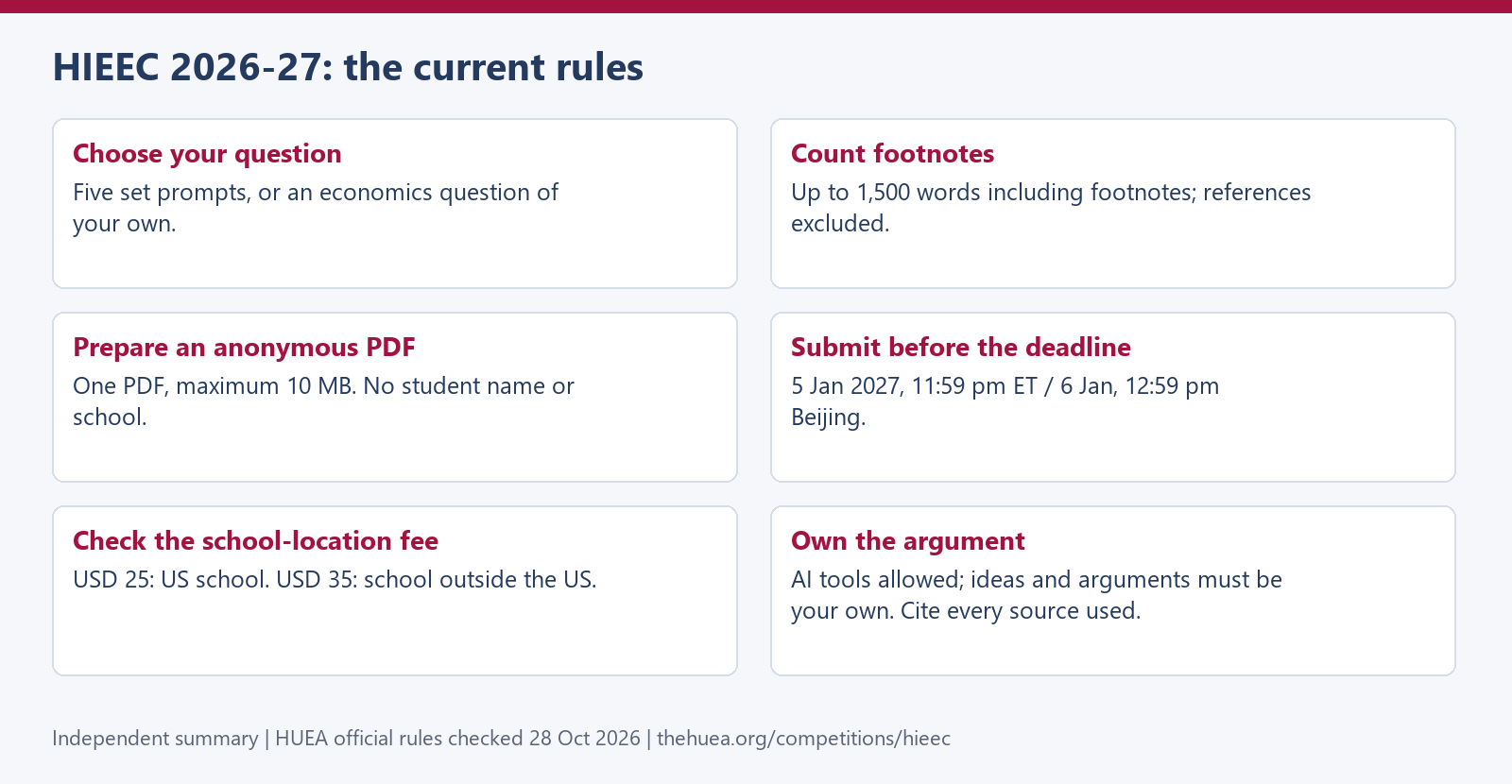
| What you write | One of five set topics plus own-question option, a maximum of 1,500 words including footnotes and excluding references; use any standard consistent citation style; submitted as a single PDF of no more than 10 MB |
| Cost & limit | A reading fee per essay (USD25 for a school in the USA / USD35 for a school outside the USA). one essay per person |
| When | The 2026-27 cycle opened October 26 2026, with a deadline of January 5 2027 at 11:59 pm Eastern Time (Boston). No late entries; always confirm current cycle details on thehuea.org. |
| Official source | thehuea.org (Harvard Undergraduate Economics Association) |
Who actually runs HIEEC (read this first)
The single most common misunderstanding is the word “Harvard.” HIEEC is organised by the Harvard Undergraduate Economics Association — Harvard’s main undergraduate economics club, founded in 2000 — in conjunction with the Harvard College Economics Review. It is a student-run competition, not an official program of Harvard University, and entering it is not an application to Harvard. That does not make it unserious: top essays are ultimately adjudicated by a final panel that HUEA intends to include Harvard faculty or other economics professionals if possible. But it does mean you should treat it as a respected student-run essay contest, judge it on its own merits, and ignore anyone who implies it is “Harvard admissions.”
What you actually write
five prescribed topics plus an own-question option — five prompts built around current, relevant economic issues; choose oneone. Your response is a Your response is a argued essay — the limit includes footnotes and excludes references, so the word count is a real design constraint, not a suggestion. Essays must be written in a formal academic style(any standard consistent citation style) and submitted as a PDF. You may enter one essay per person. The skill being tested is not how much you can write, but how clearly you can build and defend an economic argument with theory and evidence inside a tight word budget.
How it is judged
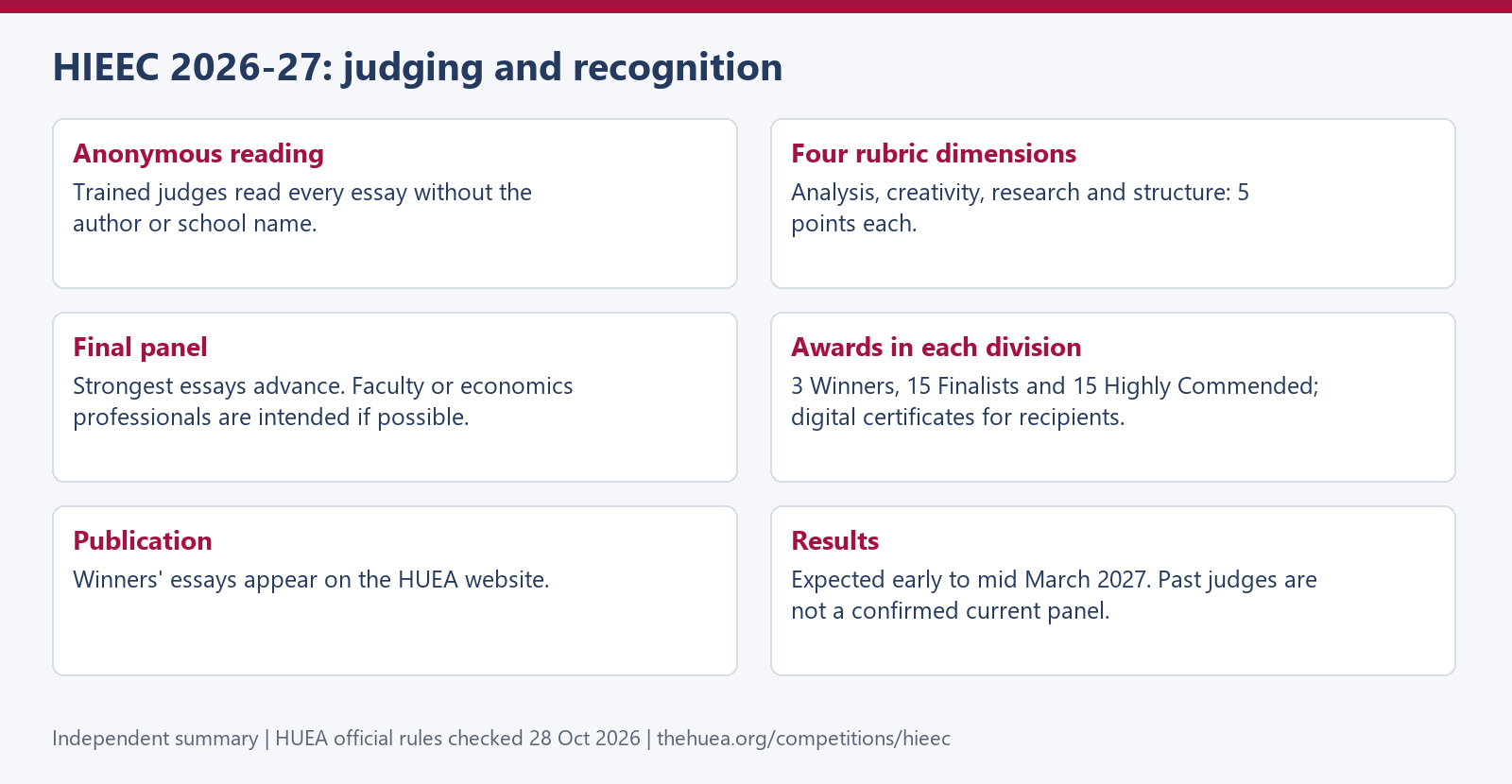
Judging runs in two stages. First, essays are read anonymously by trained judges; the strongest essays go to final panel that HUEA intends to include Harvard faculty or other economics professionals if possible. The very best essays are published on the association’s site (with the author’s permission), a finalists list is posted, and additional strong entries receive a “Highly Commended” designation. The rubric covers analysis, creativity, research and structure at five points each, so the practical guidance is to write for an expert economist reader: a clear thesis, correct use of economic theory, real evidence, and a tightly structured argument.
What a strong HIEEC essay looks like
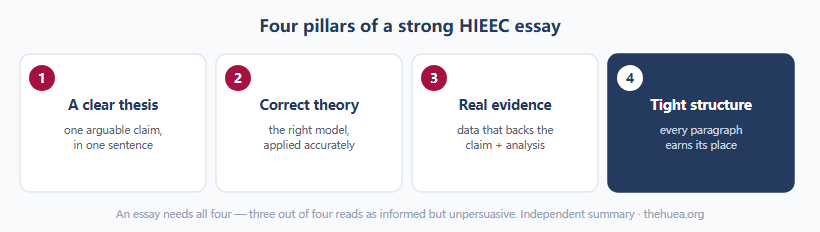
Because there is no published point-by-point rubric, the most useful question is: what does an expert economist reward? Four things, consistently. First, a clear thesis — a single, arguable claim you can state in one sentence, not a survey of “on the one hand, on the other.” Second, correct economic theory — you name the specific model the argument needs (elasticity, externalities, game theory, comparative advantage) and apply it accurately, rather than dropping terms for effect. Third, real evidence — data, studies, or concrete examples that genuinely support your claim, each followed by a sentence explaining why it matters. Fourth, tight structure — every paragraph advances the argument, and the 1,500 words go to reasoning, not throat-clearing. As a quick test: if you can delete a paragraph and your argument is unchanged, it was not pulling its weight. An essay that does all four reads as the work of someone who can think like an economist; one that does three but skips the analysis reads as well-informed but unpersuasive.
Eligibility, cost, and how international students take part
HIEEC is open to any high-school student in grades 9–12, anywhere in the world, which makes it genuinely accessible to international and China-based students — you do not qualify through a national round; you submit directly. Two practical points to plan for: there is a reading feeset by school location (USD25 in the USA / USD35 outside the USA); optional written feedback USD20 after resultsPDF in correct academic format. Work backwards from the January 5 2027 deadline: give yourself the autumn to choose a prompt, research, draft, and cut to 1,500 words. New to economics essays? See our companion guides on choosing your HIEEC theme, writing to 1,500 words, and what HIEEC judges look for.
Planning your entry: a term-by-term timeline
Because HIEEC runs on a fall–winter cycle with a deadline of January 5 2027 at 11:59 pm Eastern Time, the students who do well start in the autumn and work backwards. A workable plan: in early January, the students who do well start in the autumn and work backwards. A workable plan: in late October, read the five set topics plus own-question option the day they are released, run each through a quick test of whether you have a thesis, the theory, and the evidence, and commit to one. In late October–November, research and write a first draft — deliberately over length, so you have something to cut. In December, edit ruthlessly to 1,500 words, check your Chicago or APA referencing, and read the essay aloud to catch weak sentences. Leave the final week for formatting the PDF and a last proofread, not for writing — submitting a rushed final draft is the most common avoidable mistake. International and China-based students should also confirm the deadline in their own time zone and budget for the reading fee in advance, so neither becomes a last-minute problem.
How HIEEC compares to other economics essay competitions
HIEEC is one of several essay competitions for students interested in economics, and it helps to know where it sits. Compared with the John Locke Institute‘s economics question, HIEEC is shorter (1,500 words versus 2,000) and tied explicitly to a current economic issue rather than a broad philosophical prompt. Compared with the LSESU Economics Society Essay Competition, HIEEC is run by a Harvard student club and its strongest essays go to a final panel that HUEA intends to include Harvard faculty or other economics professionals if possible, whereas the LSESU contest is UK-based. None of these is “better” in the abstract — they reward overlapping skills (a disciplined economic argument in writing), and many strong applicants enter more than one. The practical point: HIEEC’s tight 1,500-word limit and single-issue prompts make it an excellent place to practise concision and applied analysis, and a credible line on an application to economics, PPE, or business programs.
Is HIEEC worth it for college applications?
For students aiming at economics, PPE, or business, a strong HIEEC result is a credible signal — evidence that you can build a rigorous economic argument in writing, which is exactly the skill those programs value. It does not guarantee admission anywhere, and a single entry is not a “hook”; it is one component of a coherent application. The deeper value is the work itself: researching a real economic question and arguing it well in 1,500 words genuinely strengthens you as an applicant, whether or not you place. Treat it as one well-chosen, well-executed credential — not a lottery ticket.
Frequently asked questions
Is HIEEC run by Harvard University?
No. It is run by the Harvard Undergraduate Economics Association (HUEA), a student organisation, with the Harvard College Economics Review. The strongest essays go to a final panel that HUEA intends to include Harvard faculty or other economics professionals if possible, but the contest is not an official Harvard University program, and entering is not a Harvard application.
Who can enter, and what does it cost?
Any high-school student in grades 9–12 worldwide. The reading fee is USD25 for a school in the USA and USD35 for a school outside the USA; submit one essay. Confirm current fees and rules on the official site.
How long is the essay and what format?
A limit of up to 1,500 words including footnotes and excluding references, in any standard consistent citation style, submitted as an anonymised PDF of no more than 10 MB.
HIEEC runs in 2026-27 from October 26 2026 to January 5 2027 at 11:59 pm Eastern Time. Always confirm the exact date for the current cycle on thehuea.org.
How is HIEEC different from the John Locke economics prize?
HIEEC essays are up to 1,500 words and respond to one of five set topics or an own question; the strongest go to a final panel that HUEA intends to include Harvard faculty or other economics professionals if possible. The John Locke Institute’s economics question is longer (around 2,000 words) and broader. They reward overlapping skills, and many students enter both.
Do I need to have formally studied economics to enter?
No. HIEEC is open to any grade 9–12 student with an interest in economics. You do need to use economic theory correctly, so reading around your chosen prompt matters more than having taken a formal course.
Filed underEconomics Essay · International Students · What Is Hieec
This is an independent guide to the Harvard International Economics Essay Competition, operated by Hanlin Education for China-based international-school students. We are not affiliated with, endorsed by, or sponsored by the Harvard Undergraduate Economics Association, the Harvard College Economics Review, or Harvard University. Prompts, eligibility, fees and dates change by year — always confirm the current details on the official HUEA site. Confirmed errors are corrected within 7 working days.