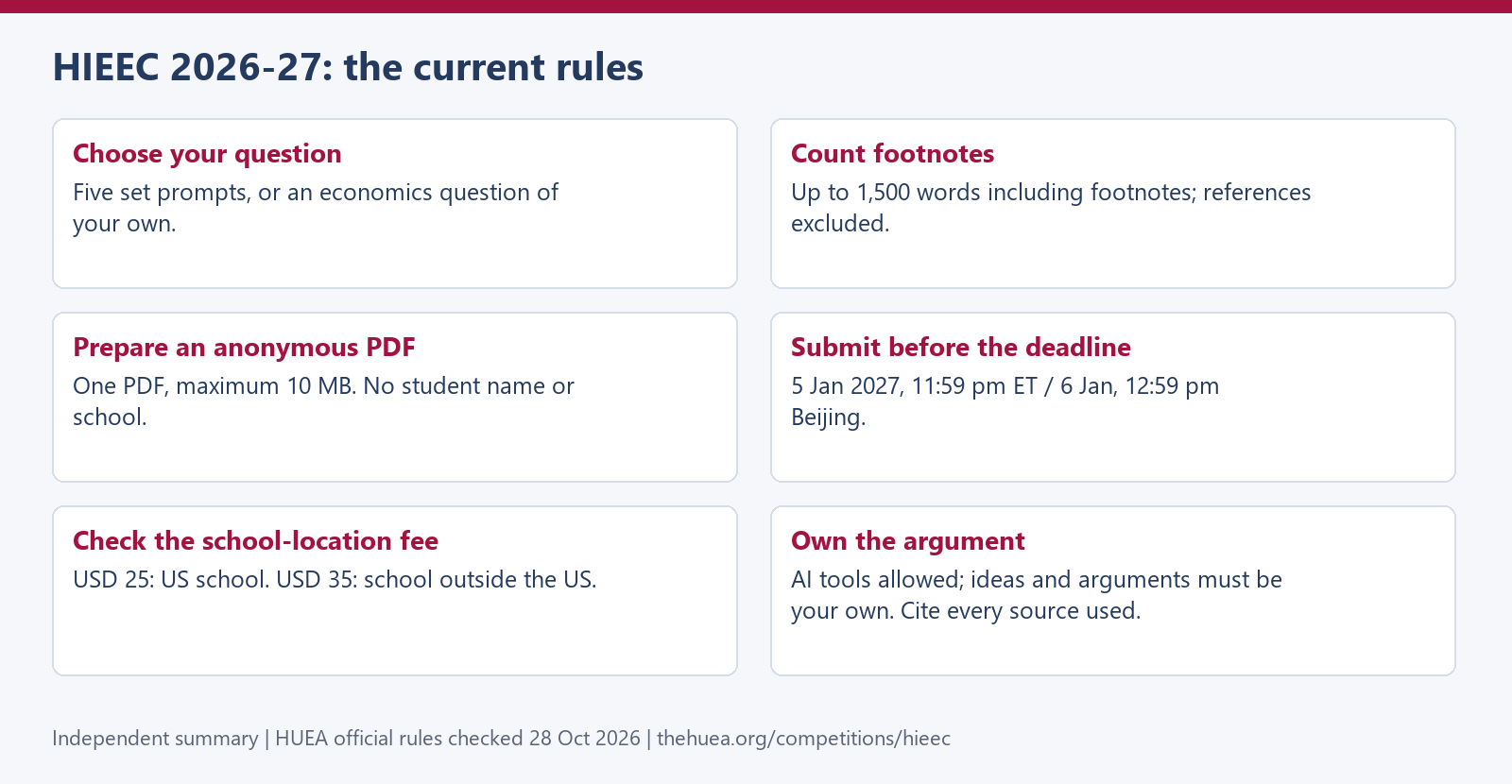
International and China-based students enter HIEEC the same way as any other high schooler: there is no nationality restriction. Per thehuea.org, the contest is open to students in grades 9–12, with two divisions based on grade at January 5 2027; you choose one of five set topics or the own-question option, write a strict 1,500 words including footnotes and excluding references in any standard consistent citation style, pay a fee set by school location (USD25 for a school in the USA / USD35 for a school outside the USA), and submit one anonymised PDF of no more than 10 MB via the official linked Tally form before the January 5 2027 Eastern Time deadline. HIEEC is run by HUEA, a Harvard student club — not Harvard University.
Who can enter from China — and who runs HIEEC
First, the positioning that trips up most families. HIEEC stands for the Harvard International Economics Essay Competition (also styled as HUEA's “Fall Essay Contest”). It is organised by the Harvard Undergraduate Economics Association (HUEA), which describes itself as a student organisation that “strives to create a more inclusive economics community at Harvard and beyond.” HUEA is a student-run undergraduate club based at the Student Organization Center at Hilles in Cambridge, MA. It is not Harvard University’s admissions office, and entering HIEEC does not create any relationship with the University. We say this plainly because the word “Harvard” in the title leads some to imply more than the official source supports. Treat it as a respected student-run essay contest; HUEA intends to involve Harvard faculty or other economics professionals in the final panel if possible, but that is not guaranteed.
On eligibility, the official page is refreshingly simple: grades 9–12 are permitted, with two divisions based on grade at January 5 2027 — grades 9-10 and grades 11-12 (including gap year or military service in the senior division). There is no clause excluding students outside the United States, no “must attend a US school” requirement, and no separate “international division.” A Year 11 student at a Shanghai or Shenzhen international school sits in exactly the same pool as a US 11th-grader. If you are in the IB, A-Level, or AP track and currently in grades 9–12, you qualify. The only line the official source draws is that the essay must be your own ideas and arguments, one essay per student, with AI tools allowed but every source used must be cited. For a fuller primer on what the contest is, see our companion piece, What Is HIEEC.
The format you must hit: 1,500 words, one prompt, PDF
HIEEC is a tight-format contest, and the constraints are non-negotiable. The official requirements, as listed on thehuea.org for the 2026–27 cycle:
- Word limit: 1,500 words, strict. The count includes footnotes and excludes references. Treat 1,500 as a hard ceiling, not a target you can overrun.
- Choose one of five set topics or the own-question option. Five prescribed topics plus an own-question option are released each cycle; you write on exactly one. We do not reproduce current wording here because topics change year to year — read them live on the official site, and see how to choose your HIEEC prompt for a selection framework.
- Citations: any standard consistent style. Pick one style and apply it consistently. For an economics essay, in-text data and source attribution matter, so build your reference list as you draft, not at the end.
- Format: single PDF, maximum 10 MB. Export your final file as a PDF before submitting.
- One essay per student; ideas and arguments your own; all sources cited. The current page states one essay per student; it does not state an exclusivity or reuse rule, so confirm with HUEA before reusing an essay published elsewhere.
For international students specifically, the 1,500-word ceiling is the single biggest adjustment. If English is your additional language, the instinct is to over-explain — and over-explaining is exactly what burns your budget. The discipline that wins is one tight argument, well-evidenced, ruthlessly cut. Our full walkthrough on staying inside the limit lives at writing the 1,500-word HIEEC essay.
The fee and the deadline — in Beijing time
Two procedural facts matter most for China-based entrants, because they differ from the US experience: the fee tier and the timezone.
Fee. The reading fee is USD25 for a school in the USA and USD35 for a school outside the USA, paid upon submission of the essay. If you are sitting at an international school in China, your school is outside the USA: budget the $35. The official page notes that fee-waiver requests go through competitions@thehuea.org before submitting. For card difficulty, fee waivers, or group school invoices, contact competitions@thehuea.org before submitting; do not assume a fee waiver is automatic. Optional written feedback is USD20 after results.
Deadline and timezone. This is where international entrants lose essays every year. The official deadline for this cycle is January 5th, 11:59 PM Eastern Time, 2027. HIEEC runs on US Eastern Time, and China Standard Time (Beijing) is 13 hours ahead of EST. So the cutoff in Beijing is roughly 12:59 PM on January 6th, 2027 — the afternoon after the date printed on the page. If you mentally file “January 5th” as your deadline and plan to submit on the evening of the 5th Beijing time, you are fine; but if you wait until late on January 6th Beijing time, you have already missed it. Always confirm the exact date and time on the official site each cycle, and convert it to your local time before you plan. Note too that there is a hard deadline and no late entries for the cycle — another reason not to leave it to the final hours.
| Item | US applicant | China-based / international applicant |
|---|---|---|
| Eligibility | Grades 9–12 | Grades 9–12; two divisions at Jan 5 2027 |
| Reading fee | USD25 | USD35 |
| Word limit | Up to 1,500 words including footnotes and excluding references | |
| Prompts | Choose 1 of 5 topics plus own-question option | |
| Citation | Any standard consistent style | |
| File format | Single PDF, max 10 MB | |
| Deadline reference | Jan 5 2027, 11:59 PM Eastern Time | Jan 5 2027, 11:59 PM Eastern Time → Jan 6 2027, 12:59 PM Beijing |
| Submissions | One essay per student; ideas and arguments own; all sources cited | |
How you actually submit: the entry path, step by step
Here is the part where the fact-check matters most, so we will be precise about what the official source does and does not say. Based on thehuea.org, there is no separate “register first, then submit” step stated; you submit through the official linked Tally entry form, and the reading fee is paid at the point of submission. If you have entered other competitions that issue a candidate ID at registration, do not assume HIEEC works the same way — it does not appear to, per the official instructions. Confirm the exact mechanics in the live form before you start.
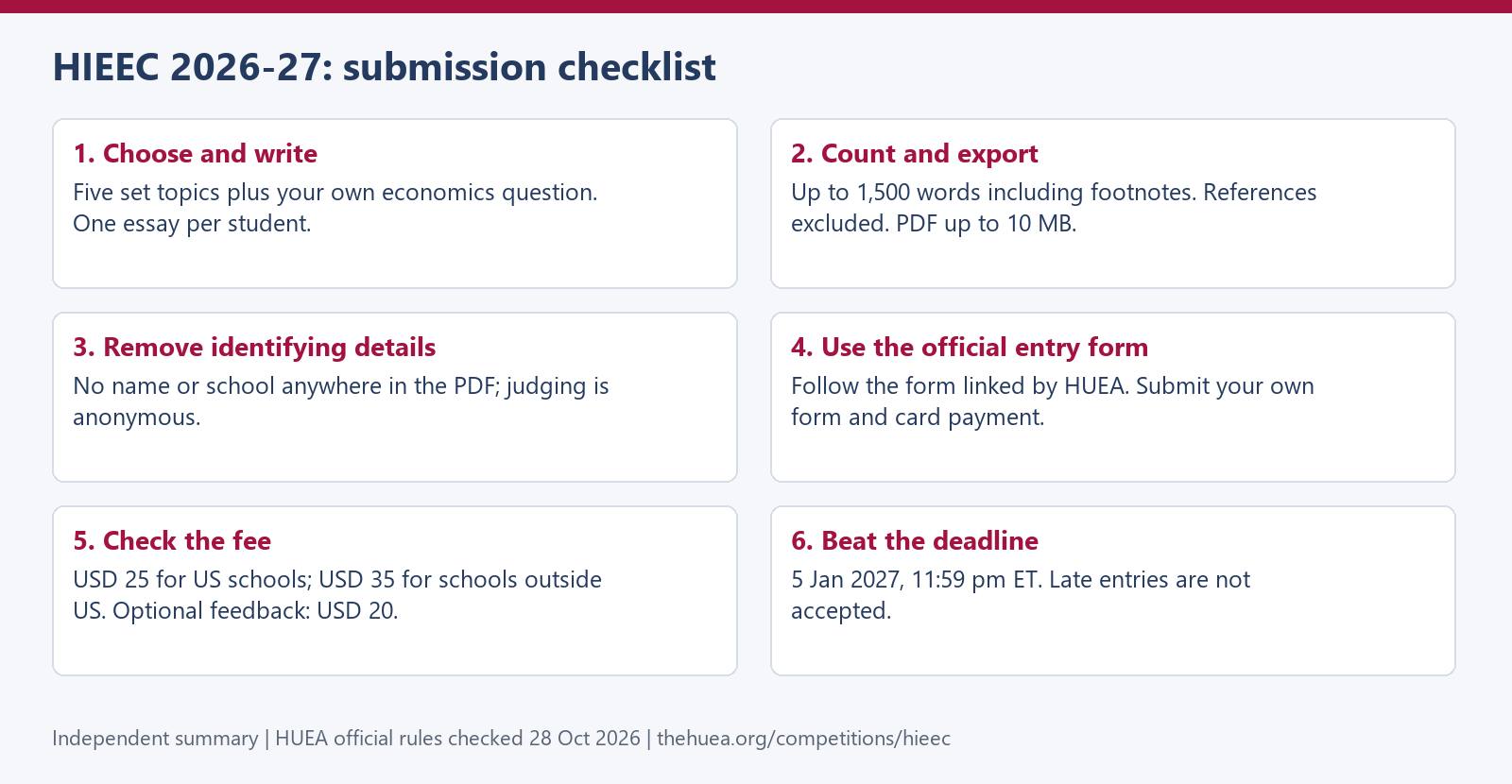
A clean entry sequence for a China-based student:
- Read the five set topics plus own-question option on thehuea.org and choose one. This is a strategic choice, not a coin flip — pick the prompt where you have a genuine angle and accessible data.
- Draft to 1,500 words. Build your references in one consistent citation style as you write. Keep the essay within 1,500 words including footnotes and excluding references.
- Export to PDF. Check that footnotes and your reference list render correctly in the exported file.
- Open the official linked Tally entry form and read every field carefully — the official site warns that failing to complete any step correctly may mean your submission is not considered.
- Pay the fee by school location (USD35 outside the USA; USD25 if your school is in the USA) at submission. For card difficulty, a fee waiver, or a group school invoice, email competitions@thehuea.org before submitting.
- Submit before the Eastern Time cutoff — planned in Beijing time. Aim to finish a full day early; with no late entries, there is no room for a last-minute scramble.
What happens after you submit — and a realistic take on value
Judging, per the official source, works in two stages: essays are read anonymously by trained judges, and the strongest essays go to a final panelRecognition is awarded per division: 3 Winners whose essays appear on the HUEA website, plus 15 Finalists, and 15 Highly Commended recipients named with school and digital certificate. There is no separate international prize tier announced; the two divisions are based on grade, and everyone in a division answers from the same choices.
On the question every parent asks — is it “worth it” for admissions? Be honest with yourself. HIEEC is a credible, low-cost way to (a) practise writing a disciplined economics argument under a hard word limit, and (b) earn a verifiable distinction if you place. It is not an admissions guarantee to Harvard or anywhere else, and no essay contest is. The value is the writing reps and a line you can speak to in interviews, not a backdoor. As a first-party note on tutoring: our team has a strong record coaching students to wins in comparable economics essay competitions — including multiple John Locke Institute economics-essay placements (those are John Locke results, not HIEEC results). We mention that only to be transparent about where our coaching experience comes from; the skills transfer, but we never relabel one competition's wins as another's.
FAQ
Can students based in China enter HIEEC?
Yes. Per thehuea.org, the contest is open to high school students in grades 9–12 with no nationality restriction and two divisions based on grade at January 5 2027; China-based international-school students outside the USA pay the USD35 fee.
Do I need to register before submitting, or get a candidate ID?
The official site does not state a separate registration step or candidate ID — you submit your essay via the official linked Tally form and pay the fee by school location at submission. Always confirm in the live form.
What is the deadline in Beijing time?
The official cutoff is January 5th, 11:59 PM Eastern Time, 2027. Beijing is 13 hours ahead, so that is 12:59 PM on January 6th 2027 Beijing time. Confirm the exact time each cycle.
Is HIEEC run by Harvard University?
No. HIEEC is run by HUEA, the Harvard Undergraduate Economics Association — a student-run undergraduate club, not Harvard University. The strongest essays go to a final panel; HUEA intends to include Harvard faculty or other economics professionals if possible.
This is an independent guide operated by Hanlin Education for China-based international-school students. It is not affiliated with, endorsed by, or sponsored by HUEA (the Harvard Undergraduate Economics Association), the Harvard College Economics Review, or Harvard University. Competition details change each cycle — always confirm current eligibility, fees, prompts, deadlines, and submission rules on the official site, thehuea.org. Confirmed errors are corrected within 7 working days.