Students and parents searching for “HIEEC submission cap” usually want one thing answered quickly: does the 600-essay limit apply to the 2026-27 Harvard International Economics Essay Competition (HIEEC)? Based on the verified 2026-27 rules checked on 2026-10-28, the answer is no: the 600-essay submission upper limit was a 2025-26 rule and is not listed for 2026-27. The verified 2026-27 rules do not specify a 600-entry cap; do not treat the old figure as a current eligibility barrier or deadline, and do not infer unlimited entries from its absence. Confirm any quota details with HUEA.
What the Source Actually Says About the 2025-26 Limit
The clearest historical statement about the 2025-26 limit comes from Hanlin Course, a Chinese education provider, in an overview published on 21 October 2026. That overview, titled “Hosted by Harvard! How to take part in the 2027 HIEEC Harvard Economics Essay Competition…”, lists the main requirements of the 2025-2026 season. Among them, it notes that the season set a 600-essay submission upper limit. The same overview treated the 2027 season’s rules as still to be confirmed; HUEA’s verified 2026-27 rules checked on 2026-10-28 do not list a 600-essay cap.
Two things follow from that. First, the 600 figure is real for 2025-26 — it is not a rumour or an estimate. Second, it is season-specific and is not listed in HUEA’s verified 2026-27 rules. A historical cap is evidence about one past cycle, not a prediction about the next one.
The same source also records other 2025-26 requirements that shape preparation, even if they too may change: individual entry, one essay per candidate, English language, no more than 1,500 words, PDF format, APA or Chicago citation, and independent work with properly declared external assistance. Eligibility was open to grades 9-12 globally, and the source states explicitly that Chinese students can participate. The 2025-26 season released four prompts covering Environment (carbon offsets), Inequality (AI-created wealth, universal basic income, data dividends), Workforce & Education (remote and hybrid work) and Crypto/Finance (blockchain government bonds). These details are useful as a calibration of scope, but they are not a promise about 2026-27.
Why a Historical Cap Is Not a Current Deadline
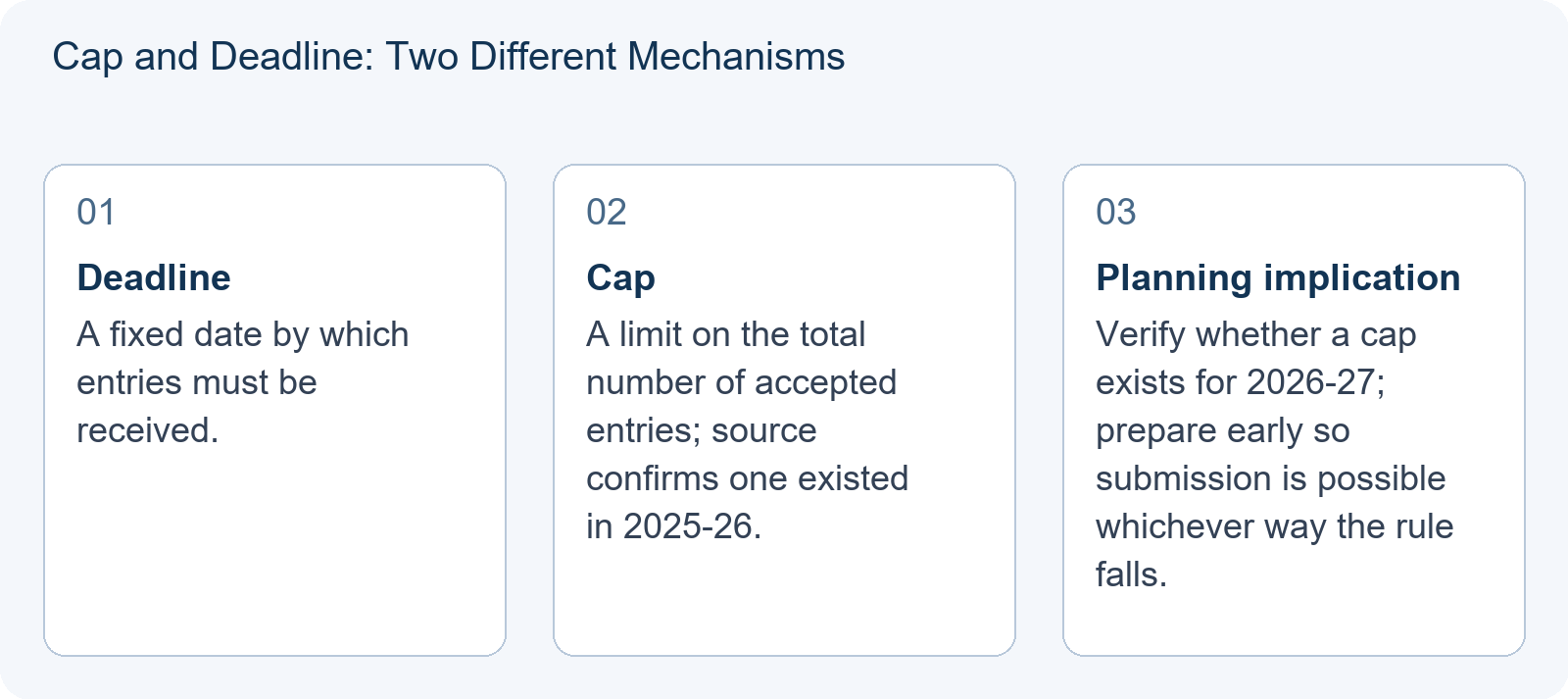
A deadline and a cap are different mechanisms. A deadline is a fixed date by which entries must arrive. A cap is a limit on the total number of accepted entries. They can interact — if a cap were reached before the deadline, an organizer might close the window early — but the source note does not state that this happened in 2025-26, and it certainly does not tell us what would happen in 2026-27. The honest reading is that the 600-essay figure tells us a cap existed once; it does not tell us how that cap was enforced, whether it triggered early closure, or whether any cap will exist next season.
Treating the 600 figure as if it were a current deadline creates two mistakes. The first is panic: a student may rush a weak draft in the belief that the portal will shut unpredictably. The second is misplaced planning: a student may calculate backwards from an unconfirmed cap and miss the confirmed timeline that actually matters. HUEA has confirmed the 2026-27 timeline: the season opened October 26, 2026; the deadline is January 5, 2027 11:59 pm Eastern Time Boston (January 6, 2027 12:59 pm Beijing); results are expected early to mid March 2027. That timeline, not the historical cap, is the anchor for planning.
What the Cap Does Not Tell You
It is worth being precise about what the 600-essay figure cannot support, because assuming that other rules stayed static alongside a cap is a common logical slip.
- It does not define eligibility. Eligibility in the previous cycle is recorded as grades 9-12 globally, but the cap itself says nothing about grade, region or student status.
- It does not set the word count. The 2026-27 limit is up to 1,500 words including footnotes but excluding references; the cap itself says nothing about word count.
- It does not set the fee. The 2026-27 fee is USD25 for a school in the USA and USD35 for a school outside the USA, based on school location; the cap itself says nothing about the fee.
- It does not measure competitiveness. A cap is an administrative constraint on the number of accepted submissions. It is not a quality threshold, a ranking mechanism or a signal about how many strong entries a season attracts.
- It does not tell you how a future cap would be administered. Whether a future cap would apply to the total pool, be resolved by early closure, or be handled some other way is not stated in the source and should not be asserted.
Planning Rule: Draft Early for Readiness, Not for a Quota
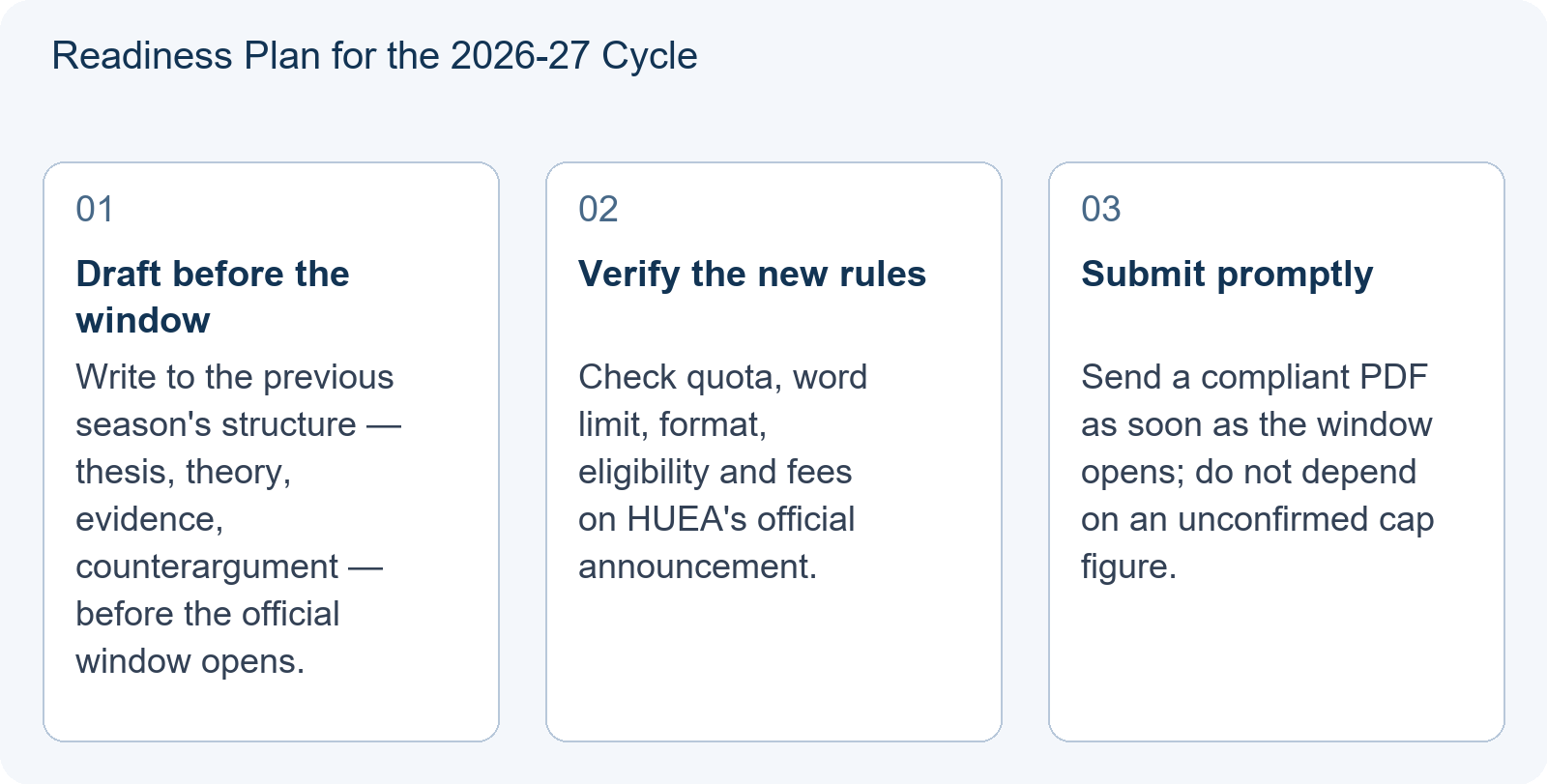
The practical rule is simple and does not depend on whether a cap is reintroduced. Prepare a complete, compliant draft before the official window opens, and be ready to submit promptly once the rules are confirmed. This is readiness planning, not deadline panic.
Readiness has three concrete components. First, choose among HUEA’s 2026-27 five prescribed topics plus the own-question option, and read the exact wording from the existing HUEA link. Second, write to the confirmed 2026-27 standard: up to 1,500 words including footnotes but excluding references, with any standard consistent citation style. Third, assemble your formatting materials early: single PDF maximum 10 MB, anonymous with no name or school anywhere in the PDF.
This approach is robust to both outcomes. If a cap returns, you are ready to submit immediately. If no cap exists, you have simply written a stronger essay with time to revise. Neither branch depends on guessing an unconfirmed number.
A Checklist for the 2026-27 Official Announcement
The 2026-27 rules have been published; verify each item directly from HUEA’s official channels rather than from memory or third-party summaries.
- Submission quota: Is a maximum number of accepted entries stated? If yes, what is the figure and how is it administered?
- Word limit: Is the limit still approximately 1,500 words, or has it changed?
- Format and citation: Are the single PDF, 10 MB maximum, and any standard consistent citation requirements unchanged?
- Eligibility: Are grade and geographic criteria unchanged?
- Fees: Is there a registration fee, and what are the payment methods?
- Timeline: What are the confirmed prompt release, submission deadline and results dates for the new cycle?
Because the source treats all of these as season-specific, the checklist is not a formality. It is the difference between planning on confirmed facts and planning on assumptions carried over from a previous cycle.
Fallback Planning If a Cycle Does Not Go to Plan
If a cap is reinstated and you are unable to submit within the window, or if you miss the deadline for another reason, the strongest response is to reuse the work rather than abandon it. A completed economics essay draft can be improved for a later cycle, adapted for a school research project, or used as the foundation for another economics writing opportunity. Our guide on HIEEC Late Submission: Planning Your Next Essay After Missing a Deadline sets out a practical sequence for carrying a draft forward. Readers who are weighing timing against the university application calendar may also find our discussion of Should a Grade 12 Student Enter HIEEC? Fitting a January Deadline Around Applications useful, and anyone who wants the current confirmed picture for the 2026-27 cycle should start with What HIEEC Has Confirmed for 2026-27 (and Four Claims We Could Not Verify).
Conclusion: Verify the Rule, Then Prepare the Essay
The 600-essay cap is a useful lesson in how to read competition information. It was real for 2025-26, it was season-specific, and it is not listed in the verified 2026-27 rules. The correct response is not to guess whether a cap will return, but to build a draft that is ready to submit by the confirmed deadline — and to verify every rule from HUEA’s current announcement. Quality and readiness travel well across cycles; an unconfirmed quota does not.
Applying the Cap Logic to Draft Readiness
The distinction between a historical cap and a current deadline is not just administrative trivia; it dictates how you allocate preparation time. A common error is treating the 600-essay limit as a signal of scarcity, leading students to rush their first draft in fear of missing a non-existent window. Instead, use the cap’s absence from confirmed 2026-27 rules as a prompt to focus on quality over speed.
Consider this diagnostic: If you are currently drafting your essay, ask yourself whether your urgency stems from a verified submission date or an assumed quota. If the latter, you are misapplying historical data. The source explicitly states that 2025-26 requirements, including the cap, cannot be reused for 2026-27. Therefore, any planning based on beating a hypothetical 600-entry cutoff is speculative.
A practical next step is to decouple your writing schedule from unconfirmed constraints. Set internal milestones based on the confirmed 2026-27 timeline: the season opened October 26, 2026, and the deadline is January 5, 2027 11:59 pm Eastern Time Boston (January 6, 2027 12:59 pm Beijing). For example, if you finish a complete draft by December, you are ready regardless of whether a cap exists. This approach transforms the uncertainty of the cap into a clear action item: verify current rules directly from HUEA, but do not let a hypothetical return distort your current workflow. By anchoring your efforts to the known timeline rather than the unknown quota, you ensure that your preparation remains robust against both scenarios—a capped season or an uncapped one.
General event background is available at Event background.
This is an independent preparation guide, not affiliated with, endorsed by, or sponsored by the Harvard Undergraduate Economics Association.
Frequently Asked Questions
Is the 600-essay limit confirmed for 2026-27?
No. The 600-essay submission upper limit is associated with the 2025-2026 season. HUEA’s verified 2026-27 rules checked on 2026-10-28 do not list a 600-entry cap; do not infer unlimited entries from its absence, and confirm any quota details with HUEA.
Does the 600 figure apply to all countries?
The source note records the 600 figure as a season-wide requirement of the 2025-26 HIEEC season and does not describe how it was applied across countries. Eligibility for that season was recorded as grades 9-12 globally, but no country-level breakdown of the cap is stated, so no such claim should be made.
Should I rush my essay because of the cap?
No. Rushing risks quality. The verified 2026-27 rules do not list a 600-entry cap, and the stated deadline is January 5, 2027 11:59 pm Eastern Time Boston (January 6, 2027 12:59 pm Beijing). Prepare a complete draft early and submit promptly once the official window opens.