If you are searching for the HIEEC blockchain prompt, you are most likely looking at the 2025-26 Crypto/Finance question. The 2025-26 season asked whether government bonds adopting blockchain technology would improve financial transparency or introduce new risks. That prompt belongs to the 2025-26 season, not the current 2026-27 set. According to the Hanlin course report “Harvard Hosted! How to Participate in the 2027 HIEEC Harvard International Economics Essay Contest?” (Hanlin WeChat source, published 21 October 2026), that was a pre-release outlook. HUEA has since opened the 2026-27 season on October 26, 2026, with a January 5, 2027 11:59 pm Eastern Time Boston deadline (January 6, 2027 12:59 pm Beijing) and results expected early to mid March 2027. The 2026-27 set includes five prescribed topics plus an own-question option; this blockchain question remains a clearly dated 2025-26 past-prompt practice exercise, not one of the current set. Read the current topics from the existing HUEA link for exact wording.
What the 2025-26 Crypto/Finance Question Actually Asked
The same Hanlin report lists four 2025-26 prompt areas: Environment (whether carbon-offset markets can help global emissions reduction and how they affect trade, investment and development), Inequality (how AI-created wealth should be distributed, and whether UBI or data dividends can narrow income gaps), Workforce & Education (how remote and hybrid work change cities, jobs and skills), and Crypto/Finance (whether government bonds adopting blockchain technology improve financial transparency or add new risks).
The report also records that the three 2025-26 winners discussed topics including blockchain and government bonds, remote work and urban population change, and UBI. That is a useful signal about how successful submissions read: the writers took a technical object — a distributed ledger — and pushed it back into a question about institutions, incentives and public debt.
One scope note matters. The Hanlin report describes the previous season’s requirements and caps, and explicitly warns that 2026-27 word limits, fees, submission caps and submission rules must come from the new season’s official announcement. The source states the previous ceiling as “no more than 1,500 words.” For 2026-27, HUEA’s verified rules specify up to 1,500 words including footnotes, excluding references; use that confirmed rule for a live entry.
Turning a Blockchain Topic into an Economic Thesis
The trap with a blockchain question is that the obvious first draft becomes a technology explainer: hashes, consensus, immutability, smart contracts, node counts. Such an essay can be technically accurate and economically empty.
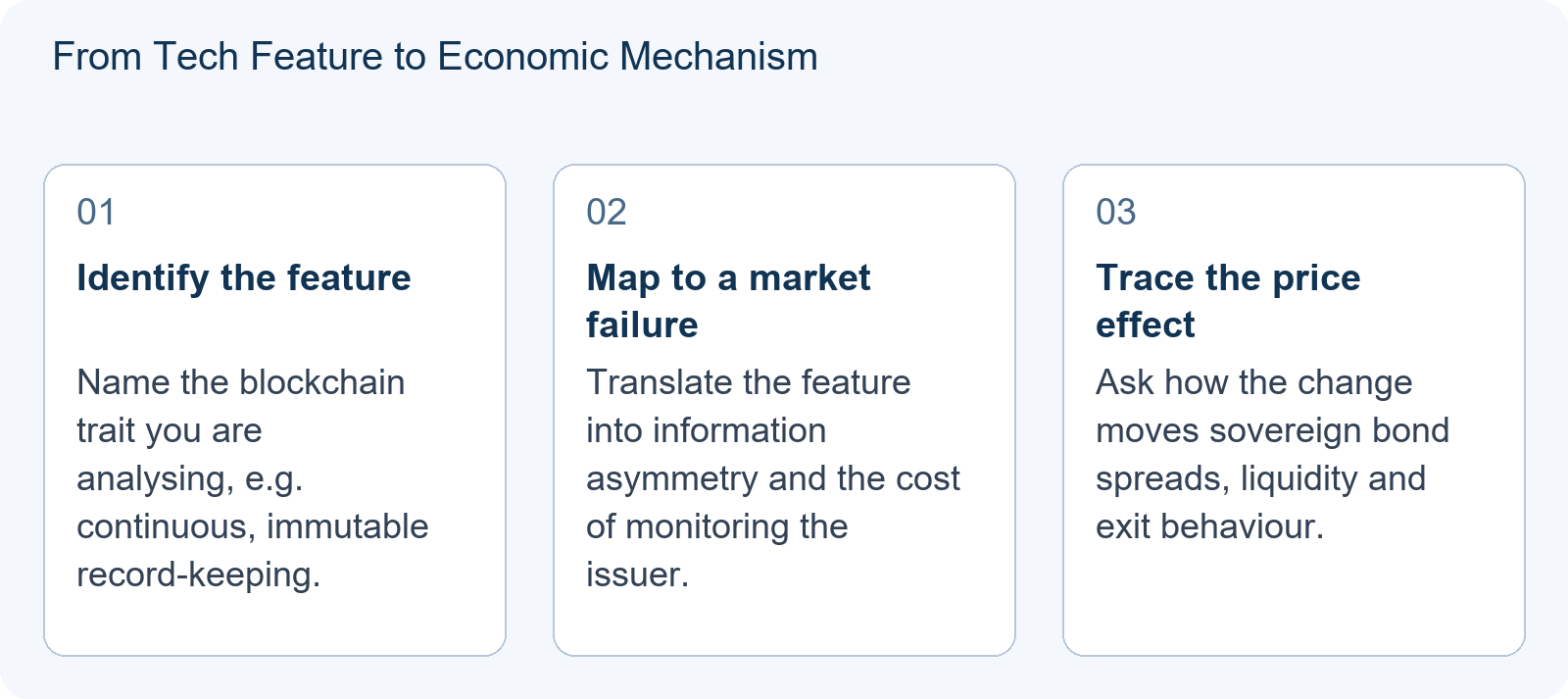
A better frame is information economics. Sovereign bond markets exist because investors must assess default risk without direct access to a government’s balance sheet. Rating agencies, primary dealers, clearinghouses and audited fiscal reports are all monitoring devices that reduce information asymmetry between the issuer (the state) and the buyer (the investor). Every monitoring device has a cost: fees, delays, disclosure lags, and the political temptation to shade numbers when a quarterly report is the only visible signal.
Blockchain’s claim, in this frame, is that it lowers the cost of monitoring. If trades and holdings are recorded on a shared ledger, investors no longer have to trust an intermediary’s summary; they can verify. That claim has economic content only if you then ask:
- Who bears the cost of false or delayed disclosure under the current system?
- Does cheaper verification actually change the price a government pays to borrow?
- Does lower information asymmetry produce a different equilibrium risk premium, or does it merely shift who holds the risk?
- What new forms of strategic behaviour appear once disclosure is continuous?
Those are the questions that distinguish an HIEEC essay from a crypto explainer.
Worked Teaching Illustration: Fictional Country ‘Ledgeria’
Note: Ledgeria is a hypothetical teaching illustration, not a real case and not an official HIEEC prompt.
Suppose a fictional middle-income country, Ledgeria, issues ten-year sovereign bonds. Under its traditional regime, debt figures and reserve levels are published quarterly, so investors who cannot see intra-quarter movement price a disclosure discount into the spread. Ledgeria’s finance ministry then moves its bond registry and secondary-market trades onto a permissioned blockchain, so every trade is visible to registered participants within minutes. Consider two economic arguments that are equally coherent on paper.
Argument A — transparency lowers borrowing costs. Reducing the disclosure lag lowers the discount investors apply for uncertainty. A narrower risk premium reduces Ledgeria’s interest bill and frees fiscal space.
Argument B — transparency can amplify runs. If investors observe a sudden decline in reserves in real time, the same immediacy that reduces uncertainty can coordinate a sell-off. Classical bank-run logic shows how common knowledge of deterioration can trigger a run that staggered, opaque disclosure might have prevented, at least temporarily.
Neither argument is automatically correct. The same technological feature — immutability plus timeliness — maps onto two opposite economic effects. A competent essay specifies the conditions under which each dominates: whether the shock is idiosyncratic or common, whether holders are diversified funds or concentrated retail investors, and whether the central bank can credibly backstop liquidity.
Ten-Minute Diagnostic: Is Your Thesis Economic or Merely Technological?
Before you keep drafting, run this check on your practice essay.
- Technology-list test. If your opening paragraph defines blockchain or explains hashing, rewrite that paragraph. Judges already know what blockchain is; the words are better spent on the market failure.
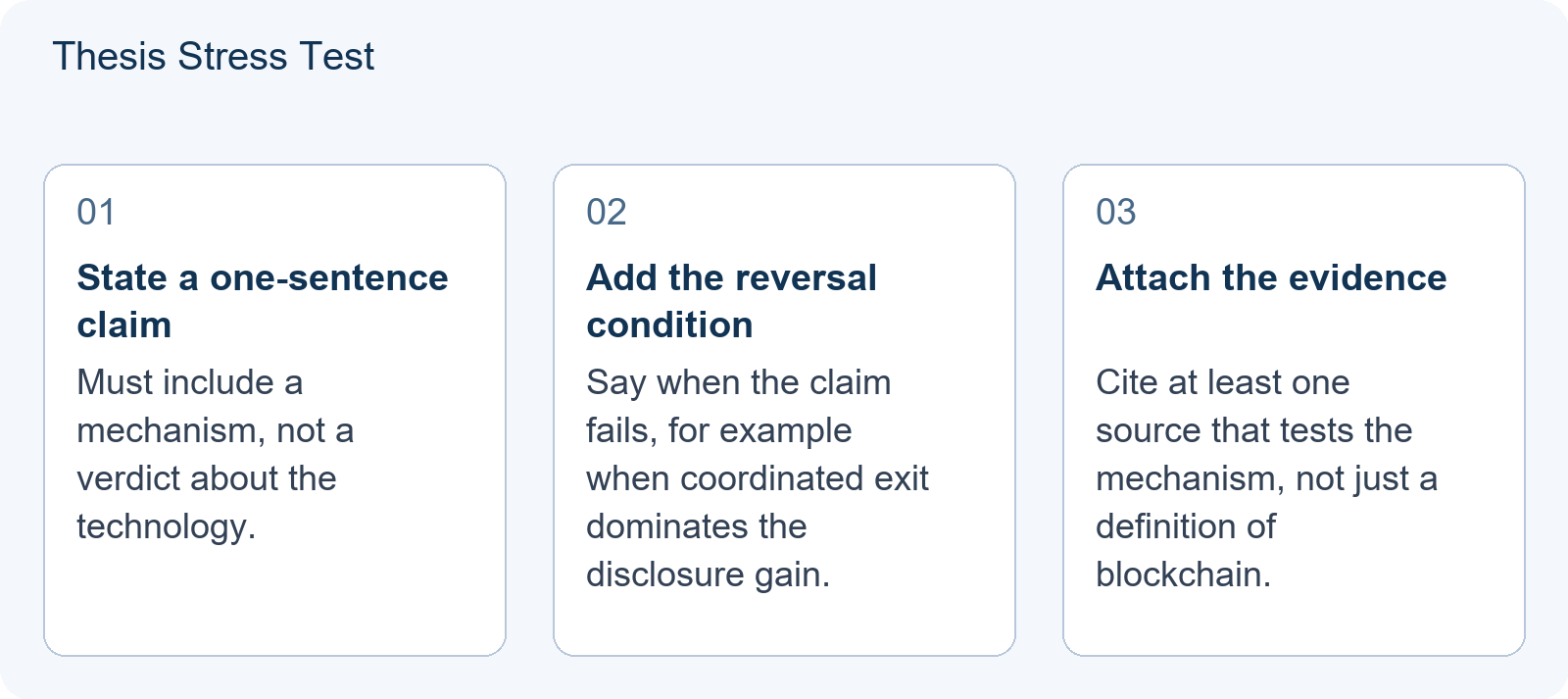
- One-sentence economic claim. Can you state your thesis in one sentence with a mechanism? Example: “Continuous disclosure reduces the information premium on sovereign debt, but it also raises the elasticity of investor exit, so the net effect on borrowing costs depends on the credibility of the backstop.” If you cannot state a claim with a mechanism, you have a topic, not a thesis.
- Counterfactual. What would the market look like if the technology were not adopted? Without a baseline, you cannot measure the change.
- Stakeholder map. Name at least three parties with different interests — the finance ministry, domestic banks, foreign institutional investors, the central bank, the taxpaying citizen. If everyone benefits, the analysis is incomplete.
Mapping Transparency to Sovereign Borrowing Costs
The strongest practice essays connect the mechanism to a price. Transparency is not a virtue in the abstract; it changes a spread. A useful chain is:
- Define the information problem precisely. Which information is delayed or unverifiable today: fiscal position, reserve holdings, secondary-market pricing, ownership concentration?
- Show how the ledger changes that. Faster, tamper-resistant recording of the same information.
- Identify the price channel. Sovereign spreads price default risk plus liquidity plus a disclosure discount. Only the disclosure component is genuinely affected.
- Bound the magnitude. If the prior disclosure discount was already small — an investment-grade borrower with strong institutions — the marginal gain is small; if the borrower faced a large opacity premium, the gain may be larger but is also correlated with a higher vulnerability to coordinated exit.
That chain — problem, mechanism, price channel, magnitude — is what a reviewer means when they say “this essay has an economic argument.”
Evidence and Counterargument Plan for a ~1,500-Word Practice Draft
A practice draft near the prior 1,500-word ceiling cannot hold five arguments. Hold two.
- Opening claim plus mechanism: ~150 words
- Evidence on the transparency side (audit trails in public finance, digitised registries, bond-market pricing studies): ~300 words
- Evidence on the risk side (cyber incidents, coordinated selling in stress episodes, settlement and operational debates where relevant): ~300 words
- Counterargument paragraph — “Why doesn’t existing central-bank reporting already solve this?” — ~200 words
- Rebuttal and conditions under which your claim holds: ~200 words
- Concluding implication for policy: ~150 words
- Transitions and citations: remaining words
Cite sources with full attribution, prefer primary data, and note that for 2026-27 any standard consistent citation style is acceptable, every source used must be cited, AI tools are optional but ideas and arguments must be the entrant’s own, and the submitted PDF must be anonymous. Even for a practice draft, applying those conventions is useful.
Practising This Prompt Alongside the 2026-27 Topics
HUEA opened the 2026-27 season on October 26, 2026; the deadline is January 5, 2027 11:59 pm Eastern Time Boston (January 6, 2027 12:59 pm Beijing), and results are expected early to mid March 2027. That leaves a short practice window for students who intend to enter. Two habits matter.
First, write a full-length draft on the 2025-26 blockchain prompt as if it were live. This tests whether your thesis survives the word ceiling now that the 2026-27 topics are available.
Second, when you take up the 2026-27 prompts, translate your method, not your content. The five 2026-27 prescribed topics — AI, globalization, digital economy, environment, and inequality — plus the own-question option show the current range, but the exact wording should be read from HUEA’s official announcement. What transfers across seasons is the analytical method: identify the market failure, name the mechanism, map it to a price or quantity, and test it against a counterargument.
For broader context, see HIEEC Winning Essays, Measured: What Nine Published Winners Have in Common (2022-2026), which surveys winning essays from 2022 to 2026. For the wider finance space, Writing the Crypto and Finance Prompt: Stablecoins, CBDCs and Monetary Control in 1,500 Words covers stablecoins and CBDCs, and How to Read an Economics Paper in 40 Minutes (and Cite It Properly in 1,500 Words) helps you process sources quickly under the word limit.
If you plan to enter the 2026-27 season, the biggest risk is producing a practice draft that feels finished but is still framed around the technology rather than the economics. A focused review should check thesis clarity, mechanism, source quality and counterargument handling — not grammar alone.
If you plan to enter when the new season opens, the biggest risk is producing a practice draft that feels finished but is still framed around the technology rather than the economics. A focused review should check thesis clarity, mechanism, source quality and counterargument handling — not grammar alone.
Under the 2026-27 rules, AI tools are allowed but ideas and arguments must be the entrant’s own, and every source used must be cited. Apply that standard while drafting. Bring a reviewer a draft, your source list, and specific questions about where your argument is weakest, rather than requesting a rewrite.
General event background is available at Event background.
This is an independent preparation guide, not affiliated with, endorsed by, or sponsored by the Harvard Undergraduate Economics Association.
Frequently Asked Questions
Is the blockchain and government bonds prompt active for 2026-27?
No. The blockchain and government bonds question belonged to the 2025-26 season. For 2026-27, HUEA lists five prescribed topics — AI, globalization, digital economy, environment, and inequality — plus the option to pose and answer your own economics question; this prompt remains past-prompt practice only. Read the exact wording from the existing HUEA link.
Can I submit a practice draft on this past prompt?
Treat it as practice material. For a live entry, answer a prompt from the official set released for the season you enter, and confirm the current rules from HUEA.
What is the biggest mistake on a blockchain-themed prompt?
Describing how the technology works instead of analysing its economic effect. Strong essays treat blockchain as a change in the cost of monitoring and ask who gains, who loses, and how the change flows into prices such as sovereign bond spreads.