A 1,500-word HIEEC essay that never names the best argument against itself reads as advocacy, not analysis. The fix is a single deliberate paragraph — roughly 180 words — that states the strongest objection in its strongest form and answers it with one clear move. This guide shows how to choose the objection, build the paragraph, and place it without wrecking your word budget.
Why the missing objection is the usual ceiling
Look at how the essays are read. HUEA states that entries are judged by the board of the association, with the top ten submissions adjudicated by an Economics Professor at Harvard — a sequence we unpack in how HIEEC's two-tier judging works. That is two different readers with two different questions. The first read asks whether the essay is competent, focused and well sourced. The second asks something harder: is this claim actually true, and does the writer know where it is weakest?
An essay with no objection paragraph can clear the first question comfortably. It rarely survives the second, because a specialist reads any strong claim by immediately generating the counter-case. If your essay has not already named that counter-case, the reader supplies it — and you are not there to answer. Every unaddressed objection becomes a doubt the reader resolves against you.
There is a second, quieter reason. Under a strict 1,500-word limit, almost every entrant can describe a topic. Far fewer can show the boundary of their own claim. Given that the published outcomes are a small set — the top three essays published online, plus a finalists list and a “Highly Commended” distinction — the marginal essay is separated by exactly this kind of discipline, not by breadth of coverage. Confirm the current judging process and award structure for your cycle on thehuea.org.
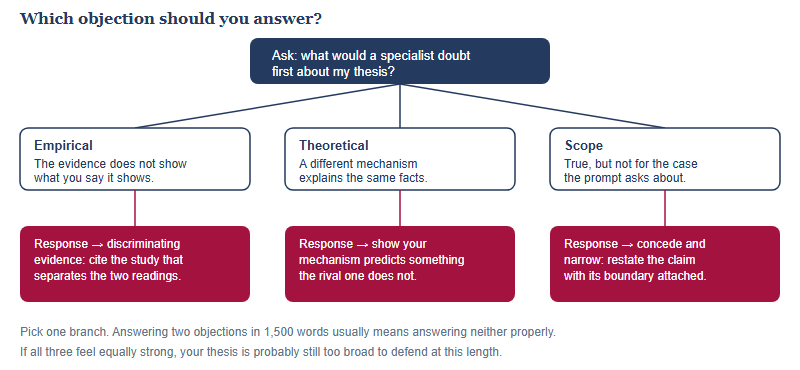
Three kinds of objection — and which one to answer
You cannot answer every objection in 180 words, and trying is how essays collapse into hedging. Sort the possible objections into three families and answer the one a specialist would raise first.
| Family | What the reader is thinking | Signal that this is your live objection | What a weak answer looks like |
|---|---|---|---|
| Empirical | “Your correlation has an obvious confounder.” | Your key evidence is a single time series or a cross-country comparison | Adding a second statistic that has the same weakness |
| Theoretical | “A standard model gives the opposite prediction here.” | Your mechanism contradicts a textbook result without saying so | Asserting your model is “more realistic” with no test |
| Scope | “That may hold in the US; the prompt is global.” | Your evidence comes from one country, sector or decade | Claiming the finding “can be generalised” without argument |
Finding your live objection takes about ten minutes if you use a generator rather than waiting for inspiration. Three work reliably:
- Reverse the thesis. Write the exact negation of your claim as a one-sentence argument. If you can build a respectable case for it in three lines, that is your objection.
- Ask what would have to be true. List the two or three conditions your mechanism silently assumes. The objection is almost always “the second condition does not hold here.”
- Read the source that disagrees. If every reference in your bibliography supports your position, you have researched to confirm rather than to test — and a specialist will notice. One paper arguing the other way, properly cited, fixes both the objection and the reading list.
If you cannot yet tell which family applies, the problem is usually upstream in prompt selection rather than in the writing — a thesis that fits the evidence you actually hold generates one obvious objection, not three. Our guide to choosing your HIEEC prompt by strength covers that diagnosis.
Anatomy of a 180-word objection paragraph
The paragraph has four moves in a fixed order. Each has a word cost you can plan around, which matters when the limit is strict and anything past 1,500 words is truncated.
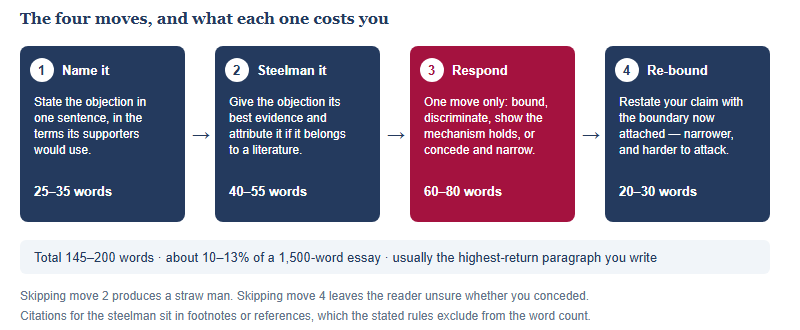
Move 2 deserves emphasis because it is counter-intuitive. Making the opposing case well feels like weakening your essay. In practice it does the opposite: a reader who sees that you can state the strongest version of the counter-case reads your response as a considered judgement rather than as ignorance of the literature. A straw man — “some people simply believe markets always work” — signals the reverse.
Four responses that actually work
Take an illustrative thesis: a carbon border adjustment reduces global emissions rather than merely relocating them. The example below is written for this guide; it is not a model answer and the empirical questions it raises remain contested in the literature.
- Bound the claim. “The mechanism operates where imported goods are close substitutes for domestic ones; where they are not, the price signal is muted.” You have not retreated — you have specified the conditions under which you are right, which is what economists mean by a result.
- Cite the discriminating evidence. Where the objection and your thesis predict different observable outcomes, name the evidence that separates them, and attribute it precisely. This is the strongest response when the disagreement is empirical rather than conceptual.
- Show the mechanism survives. If the objection proposes a rival channel, accept that it operates and argue about magnitude: which channel dominates, and what would we expect to observe if it did? A response framed in terms of relative magnitude is far more credible than one that denies the rival channel exists.
- Concede and narrow. Sometimes the objection is right. Saying so — then restating a smaller claim you can fully defend — costs you the grand conclusion and gains you the reader's trust. Under 1,500 words, a fully defended narrow claim outperforms a sweeping claim with a hole in it.
Run together, the four moves form one compact paragraph. In skeleton form: “A standard objection holds that a border adjustment shifts trade patterns rather than abatement decisions [name]. On this reading, exporters reroute output toward markets without the charge, so a fall in covered-sector imports would overstate any emissions effect — the concern at the centre of the leakage literature [steelman, cited]. The two readings differ in one observable: rerouting predicts rising exports to uncovered markets, whereas abatement predicts falling emissions intensity per unit of output, and the sectoral evidence available for [sector] points toward the second, though it is limited [respond]. The claim defended here is therefore the narrower one: the adjustment reduces emissions where rerouting options are constrained [re-bound].” That skeleton is about 130 words and does more analytical work than the 400 words of additional description it replaces.
Note what none of these four responses do: none of them hedge everything, and none of them end with “further research is needed.” That phrase is a way of avoiding a judgement. The essay is asking you to make one.
Placement, failure modes, and a six-line self-test
Where the paragraph sits changes how the essay reads. Two placements work; a third almost never does.
| Placement | Effect on the reader | Use it when |
|---|---|---|
| Immediately after your main mechanism | Reads as stress-testing your own argument while it is fresh | The objection is theoretical — a rival mechanism |
| Just before the conclusion | Reads as a final concession that narrows the claim you then state | The objection is about scope or evidence quality |
| Inside the introduction | Reads as apology; the reader now doubts before you have argued anything | Almost never — keep the opening for your claim |
The failure modes are consistent enough to check mechanically:
- The straw man. The objection is stated so weakly that answering it proves nothing. Fix: name a specific mechanism or finding, not “critics.”
- The drive-by concession. “Of course, there are counterarguments to this view.” Twelve words, zero analysis. Fix: cut it entirely or build the full four moves.
- The runaway objection. The counter-case takes 400 words and your response takes 60, so the essay ends up arguing against itself. Fix: cap the steelman at roughly 55 words.
- The universal hedge. Every claim is qualified, so no claim is made. Fix: one bounded claim, defended, beats five hedged ones.
- The orphan objection. A counterargument is raised and never answered, usually because the writer ran out of words. Under a truncating limit this is a real risk — budget the paragraph before you draft, and see our 1,500-word structure guide for how the sections should be allocated.
Before you submit, run these six lines against your objection paragraph. Every “no” is a specific rewrite, not a vague worry.
- Could someone who holds the opposing view read my sentence and say “yes, that is my argument”?
- Have I given that view its best evidence, with a source?
- Do I make exactly one response move, not three?
- Does my response point at something observable rather than at plausibility?
- Is my claim restated at the end, with its boundary attached?
- Is the whole paragraph under 200 words?
One pattern we see repeatedly in drafts from China-based students: the objection paragraph exists but is written in the passive, impersonal register of an exam answer — “it may be argued that…” — which hides who is arguing and why they would. Naming the position, the mechanism and the evidence turns the same 180 words into the paragraph that separates a competent essay from a considered one. For the wider context of how HIEEC is run and judged, start with our overview of what HIEEC is.
Frequently asked questions
How many counterarguments should a 1,500-word essay answer?
One, answered properly. Two shallow objections read as hedging; one steelmanned objection reads as judgement.
Does conceding a point make my essay weaker?
No. A narrower claim you fully defend is stronger than a sweeping claim with an obvious hole in it.
Do citations in my objection paragraph count toward 1,500 words?
HUEA states references and footnotes are excluded from the limit. Confirm the current wording on thehuea.org.
Where should the objection paragraph go?
After your main mechanism, or just before the conclusion. Never in the introduction, where it undercuts your claim.
This is an independent guide operated by Hanlin Education for China-based international-school students. We are not affiliated with, endorsed by, or sponsored by the Harvard Undergraduate Economics Association (HUEA), the Harvard College Economics Review, or Harvard University. Judging arrangements, rules and prompts change between cycles — always confirm current details on thehuea.org. Factual errors reported to our editorial desk are corrected within 7 working days.