When preparing for the Harvard International Economics Essay Competition (HIEEC), students often encounter prompts requiring them to evaluate the impact of specific economic policies. A common analytical trap is treating simple before-and-after comparisons or cross-country differences as definitive proof of causality. This article addresses the narrow but critical skill of explaining what a policy comparison can and cannot show when framed as a “natural experiment.” Unlike broad preparation guides that cover general essay structure, this piece focuses on the logical rigor required to defend causal claims in a 1,500-word limit. Understanding HIEEC Natural Experiments means recognizing where your evidence ends and your assumptions begin.
The Core Difficulty: Causality vs. Correlation
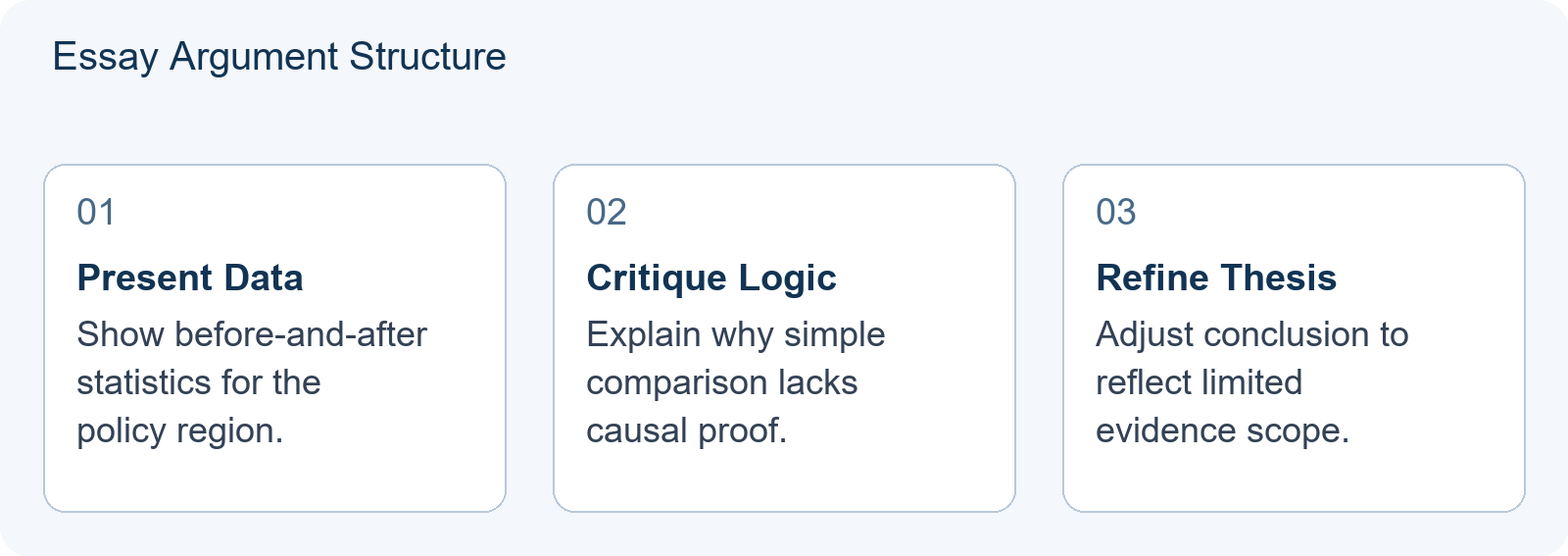
In economics, a natural experiment occurs when an external event or policy change creates a situation similar to a randomized controlled trial. However, high school essays often mistakenly assume that because two variables changed together, one caused the other. The precise difficulty lies in identifying confounding factors—other simultaneous changes that could explain the observed outcome. For HIEEC judges, demonstrating awareness of these limitations is often more impressive than asserting a strong causal link without qualification.
A policy comparison can show temporal association and directional change. It cannot show isolated causation unless the analyst explicitly addresses what else changed, what was held constant, and what alternative explanations exist. The gap between these two capabilities is where most HIEEC essays lose analytical precision.
Teaching Illustration 1: The Minimum Wage Increase
The following scenario is an original teaching illustration, not an official past-paper question or researched historical case.
Imagine Country A raises its minimum wage by 10% in 2024. In 2025, unemployment in low-skilled sectors drops by 2%. A student might argue: “The minimum wage increase caused lower unemployment.” This is a classic error. To correct it, we must ask: What else happened in 2024-2025? Did Country A also implement a job training program? Did global demand for its exports rise? Without controlling for these factors, the comparison only shows correlation, not causation.
What this comparison CAN show: The minimum wage increase and the unemployment decrease occurred in the same timeframe; the direction of change is observable.
What this comparison CANNOT show: That the minimum wage increase was the sole or primary cause of lower unemployment. The concurrent expansionary monetary policy, for example, makes it difficult to isolate the minimum wage’s specific impact. A stronger argument would state: “While the timing suggests a potential positive effect, the concurrent expansionary monetary policy makes it difficult to isolate the minimum wage’s specific impact.”
Teaching Illustration 2: The Subsidy Failure
The following scenario is an original teaching illustration, not an official past-paper question or researched historical case.
Now consider Country B, which subsidized electric vehicle (EV) purchases in 2023. By 2024, EV sales increased by 50%, while gasoline car sales remained flat. A student might claim: “Subsidies effectively shift consumer preference away from fossil fuels.” This assumption fails if we ignore supply-side constraints. Suppose Country B simultaneously relaxed import tariffs on EVs, allowing cheaper models to enter the market. The price drop, not just the subsidy, could drive sales. If the subsidy was small relative to the tariff reduction, attributing the entire 50% growth to the subsidy is logically flawed.
What this comparison CAN show: Subsidies are associated with EV sales growth in this specific period.
What this comparison CANNOT show: That subsidies were the primary driver of that growth. The comparison shows correlation, but it cannot prove causation without accounting for the tariff change. The student must ask: Would sales have risen 50% without the tariff reduction? This counterfactual is unobserved, and the comparison alone cannot reveal it.
Teaching Illustration 3: The Carbon Pricing Confound
The following scenario is an original teaching illustration, not an official past-paper question or researched historical case.
Country C introduces a carbon tax in 2022. By 2024, carbon emissions fall by 15%. A student writes: “Carbon pricing successfully reduced emissions.” However, during this same period, Country C experienced a severe recession that reduced industrial output across all sectors. Energy demand fell because factories closed, not because firms switched to cleaner technology. The policy comparison—before and after the tax—cannot distinguish between the tax effect and the recession effect.
What this comparison CAN show: Emissions fell after the carbon tax was implemented.
What this comparison CANNOT show: That the carbon tax caused the emissions reduction. Without a comparison to a similar country that had the recession but not the tax, or the tax but not the recession, the analyst cannot attribute the change to policy rather than macroeconomic conditions. This illustrates why natural experiments require either a control group or explicit discussion of why one is unavailable.
Diagnostic Table: Common Logical Errors
| Error Type | Description | What the Comparison CANNOT Show | Correction Strategy |
|---|---|---|---|
| Post Hoc Ergo Propter Hoc | Assuming that because B followed A, A caused B. | That temporal sequence implies causation. | Identify alternative explanations occurring in the same timeframe. |
| Omitted Variable Bias | Ignoring a third factor that influences both the policy and the outcome. | That the policy alone drove the observed change. | List potential confounders (e.g., global trends, other domestic policies). |
| Selection Bias | Comparing groups that were already different before the policy. | That the policy effect is generalizable or unbiased. | Use difference-in-differences logic if data allows; otherwise, acknowledge group heterogeneity. |
| Reverse Causality | Assuming A causes B when B may cause A. | The direction of causation. | Establish theoretical mechanism and temporal precedence carefully. |
Targeted Practice Sequence
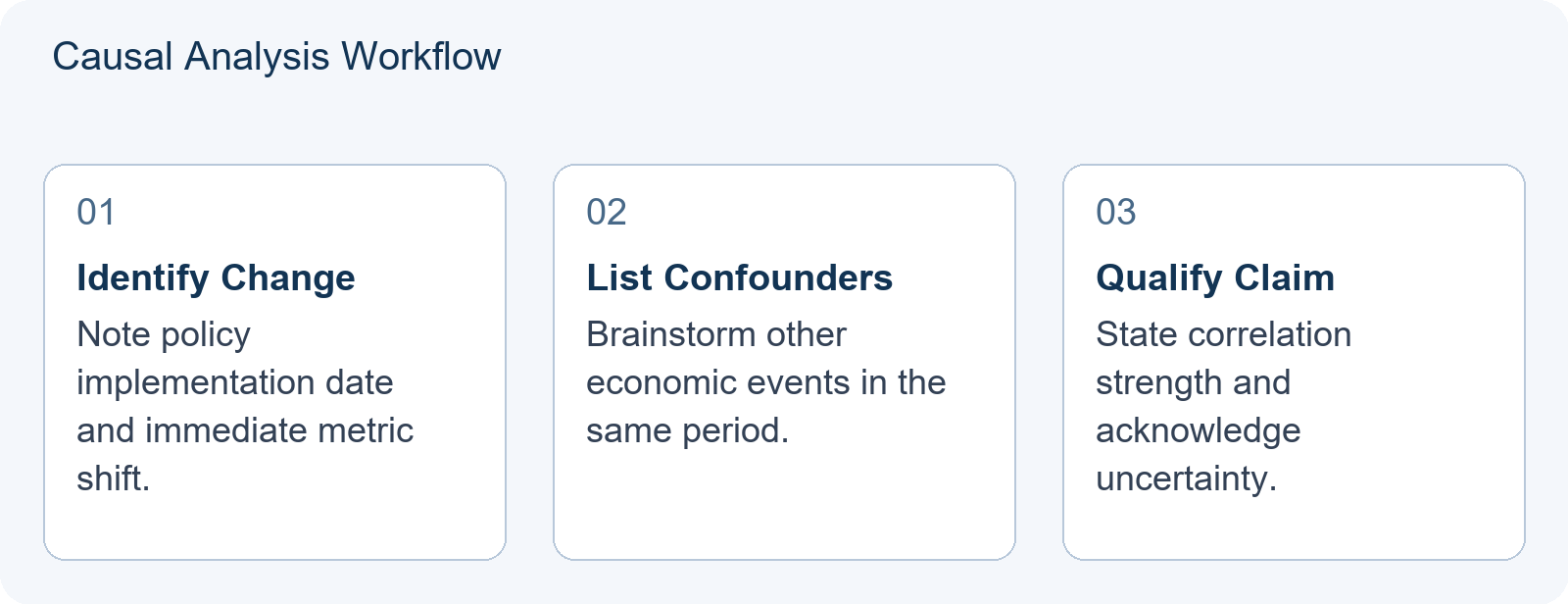
To build this skill, students should practice deconstructing existing arguments rather than writing new ones from scratch. The following four-step sequence develops the habit of identifying what a comparison cannot show:
Step 1: Isolate the Claim. Take a news headline about an economic policy. Identify the explicit or implicit causal claim. Write it in the form: “Policy X caused Outcome Y.”
Step 2: Inventory the Context. List three other events—economic, political, or environmental—that occurred during the same implementation period. Include at least one factor that affected the same outcome variable through a different channel.
Step 3: Construct the Limitation. Write one paragraph that states what the before-and-after comparison CAN show (temporal association, directional change) and what it CANNOT show (isolated causation, magnitude of policy-specific effect, generalizability to other contexts).
Step 4: Refine the Thesis. Rewrite the original claim as a qualified statement. Instead of “Policy X caused Outcome Y,” use: “Policy X is correlated with Outcome Y, though concurrent Factor Z may have contributed significantly, and the specific magnitude of X’s independent effect remains uncertain without further controls.”
This exercise directly supports the analytical depth expected in HIEEC essays on trade and industrial policy. It also prevents the common error of overstating conclusions in the final paragraph, which can undermine otherwise strong research.
For broader context on how judges evaluate reasoning, refer to our guide on HIEEC Winning Essays, Measured: What Nine Published Winners Have in Common (2022-2026). For guidance on managing word count while including necessary caveats, see How to End an HIEEC Essay: The Last 150 Words (and Why Policy Recommendations Sink Them). Additionally, What HIEEC Has Confirmed for 2026-27 (and Four Claims We Could Not Verify) provides verified information about the current competition cycle.
Next Steps for Learners
The specific skill a learner should demonstrate next is the ability to draft a thesis statement that includes a causal qualifier. This skill separates descriptive essays from analytical ones. The qualifier should appear in the introduction, recur in topic sentences, and be acknowledged in the conclusion.
Practice by selecting any two countries that implemented similar policies at different times. Compare their outcomes, but focus your analysis on what this comparison CANNOT reveal. Did they face the same global conditions? Did they have identical pre-existing trends? If not, the comparison is weakened, and stating this limitation strengthens your credibility. This nuance signals academic maturity and aligns with the expectations for independent research in economics competitions.
Frequently Asked Questions
Can I use real country data for these examples?
Yes, using real data strengthens credibility, but ensure you accurately report the timeline and avoid implying causation where only correlation exists. Always label your sources and note data limitations. When real data is unavailable or confounded, clearly state that your comparison shows association, not proven causation.
How much space should I dedicate to caveats?
A well-structured HIEEC essay typically dedicates one paragraph in each analytical section to discussing limitations. This demonstrates rigorous thinking without undermining your main argument. In a 1,500-word essay, this usually means 80-120 words per major section—enough to show awareness without defensive over-qualification that erodes your position.
Is it better to admit uncertainty than make a bold claim?
Judges typically value nuanced, well-supported arguments over bold but unsupported assertions. Admitting uncertainty shows intellectual honesty. However, complete agnosticism is also weak; the strongest essays make a qualified claim, explain the direction of evidence, and explicitly note what would strengthen or weaken their conclusion. This balanced approach demonstrates both confidence and methodological awareness.