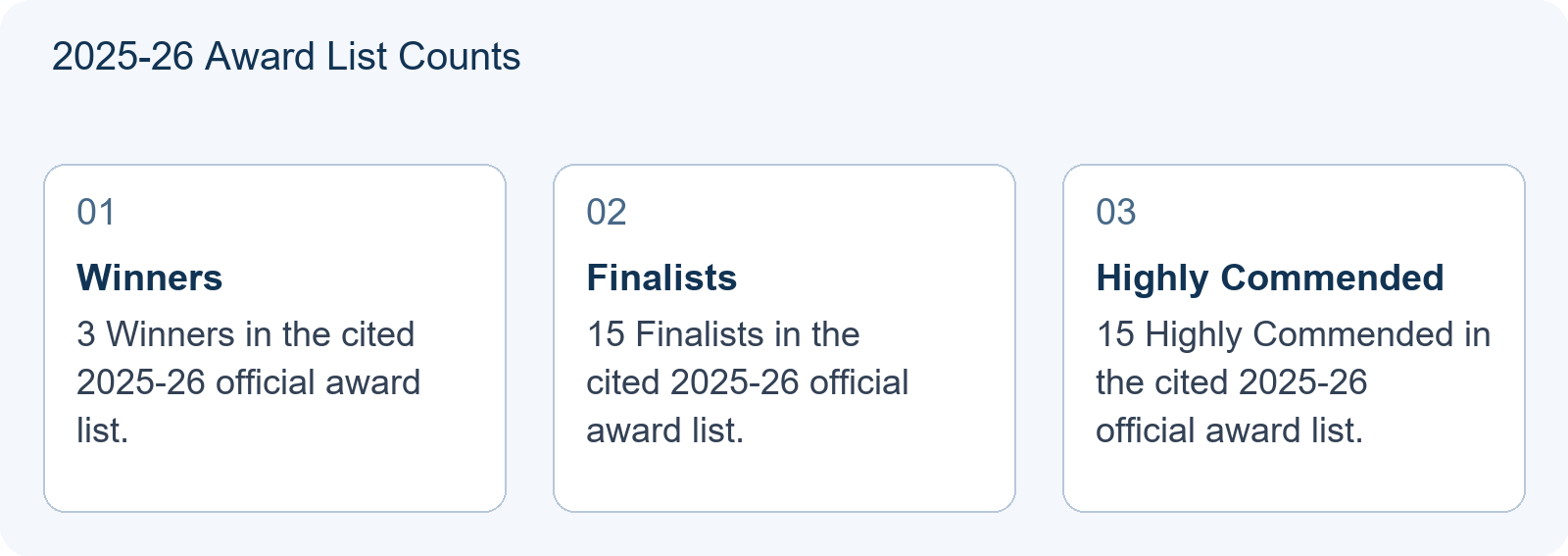
If you are searching for HIEEC award bands, the short answer is this: the 2025-26 HIEEC official award list cited in Hanlin’s October 21, 2026 preparation note used three recognition labels — Winners (3), Finalists (15), and Highly Commended (15). The same source describes an initial HUEA student committee review and a later final-panel review; HUEA intends to involve Harvard faculty or other economics professionals if possible, not guaranteed Harvard professors. The source does not define score thresholds or medal equivalents. For 2026-27, HUEA states per division 3 Winners, 15 Finalists, and 15 Highly Commended; do not sum the bands or infer overlap.
This article is for students and families who want to understand the labels themselves, not just how to report a result. It separates what the sourced 2025-26 list actually says from common assumptions about medals, ranking, and future award quotas. The primary source is Hanlin’s note titled “Harvard Hosted! How to Participate in the 2027 HIEEC Harvard International Economics Essay Contest…”, published on 2026-10-21 and retrieved on 2026-10-26.
What the 2025-26 HIEEC Award List Says
The cited 2025-26 list names three specific recognition bands. Understanding these labels requires looking at exactly what the source provides and, crucially, what it leaves undefined. Many applicants assume that “Finalist” implies a top percentage or that “Highly Commended” is a lower tier of the same category, but the source treats them as distinct named groups within the official announcement.
| Recognition Label | 2025-26 Count | What the Cited Source States | What the Source Does Not State |
|---|---|---|---|
| Winners | 3 | Named in the cited official 2025-26 award list. The source also notes that the official list published three winning essays involving remote work and urban population, blockchain and government bonds, and universal basic income. | No score cutoff, percentile band, or medal equivalent is given. There is no statement that these are the only essays above a certain threshold. |
| Finalists | 15 | Named in the cited official 2025-26 award list. | The source does not define a ranking inside the Finalist group or map the label to a single review stage. It does not state if Finalists received certificates or physical awards. |
| Highly Commended | 15 | Named in the cited official 2025-26 award list. | The source does not give a score range, certificate rule, or stage-to-label assignment. It does not clarify if Highly Commended essays were considered for Winner status. |
These counts are historical data for the 2025-26 season. For 2026-27, the verified rules state per division 3 Winners, 15 Finalists, and 15 Highly Commended; do not sum the bands or infer overlap or disjointness. The 2025-26 distribution should not be treated as a fixed template for 2026-27 preparation.
The Two-Tier Review Sequence: Context, Not a Label Rule
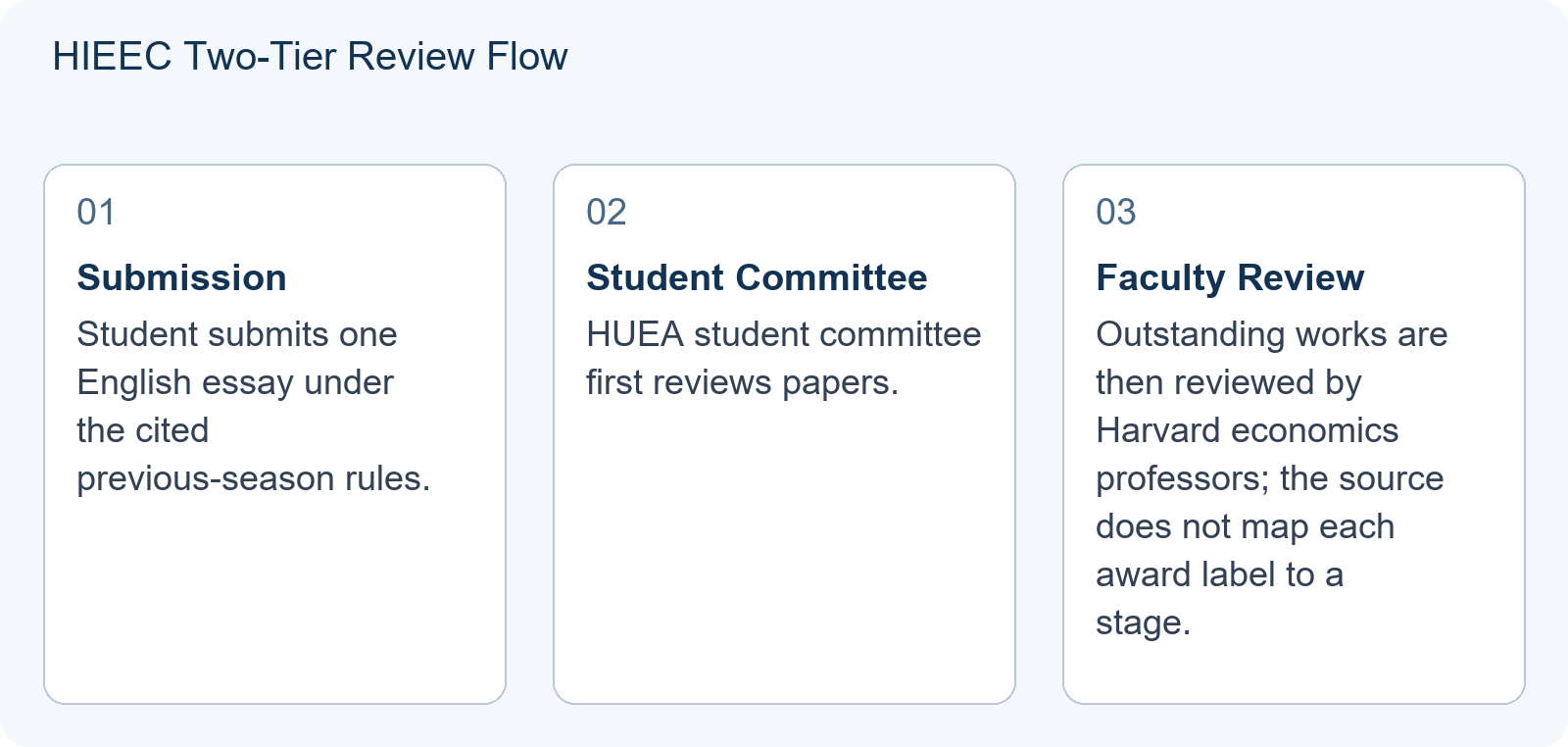
The source explains the review process in two broad stages, which helps contextualize the rigor of the competition but does not mechanically explain how each label was assigned:
- HUEA student committee review: Papers were first reviewed by the Harvard Undergraduate Economics Association (HUEA) student committee. This suggests an initial screening phase where a larger pool of essays was evaluated for basic compliance, clarity, and economic reasoning.
- Faculty review: Outstanding works were then reviewed by a final panel. HUEA intends to involve Harvard faculty or other economics professionals if possible, but Harvard professors are not guaranteed.
The same source notes that 2016 Nobel economics laureate Oliver Hart participated in past judging. That is useful historical context: it shows that HIEEC has involved serious economics faculty in past cycles. For 2026-27, HUEA intends to involve Harvard faculty or other economics professionals if possible, not guaranteed Harvard professors, and organizers do not use AI to score essays.
A common mistake among applicants is to invent a clean mapping such as “Highly Commended = student committee only” or “Finalist = faculty only.” The cited source does not make that mapping. It gives the review sequence and the final award labels, but it does not specify which stage produced which label. For instance, it is possible that the faculty reviewed both Finalists and Highly Commended essays, or that the student committee identified the pool for faculty review. Without explicit confirmation, any assumption about which reviewers saw which band is speculative. If you describe your result, do not add a stage that the official source does not state.
Why You Should Not Calculate a 2025-26 Recognition Rate from the 600 Cap
The source states that the 2025-26 season set a 600-essay submission cap. A cap is a maximum limit, not the number of essays actually submitted, not the number of eligible entries, and not the number that reached final review. Therefore, dividing 33 recognitions (3+15+15) by 600 would use an invalid denominator. It would not be a verified recognition rate.
To calculate a valid rate for any single band, you would need at least two matching numbers from the same season and population: the verified number of eligible submissions and the verified count for that band. The source provides the band counts and the cap, but not the submitted or eligible total. Because the source does not state whether bands overlap or how many total recognitions there were, you should not sum the bands or quote a combined recognition rate such as 5.5%.
The safe statement is narrower: the cited 2025-26 award list named 3 Winners, 15 Finalists, and 15 Highly Commended essays, while the season also had a 600-paper submission cap. Do not generalize cohort outcomes to all participants or infer individual success probabilities based on incomplete denominators.
How to Describe an HIEEC Recognition Accurately
If you receive an HIEEC recognition, precision helps. Admissions readers may know the competition or may look it up. Overstating a label creates avoidable risk. Here is how to frame each band based strictly on the sourced definitions:
If you are a 2025-26 Winner: Use language like, “Named one of three Winners in the 2025-26 Harvard International Economics Essay Competition (HIEEC).” If the official list published your essay, you may add that the winning essay was published in the official 2025-26 winners’ set. Do not add “out of 600 submissions” unless an official source confirms the actual number of submissions for that season. Avoid claiming “Gold Medal” unless the official certificate explicitly uses that term, which the source does not confirm.
If you are a 2025-26 Finalist: Use language like, “Named a Finalist in the 2025-26 HIEEC; 15 Finalists were listed in the cited official award list.” Avoid “top 15” unless the official source explicitly uses that phrase. The count is 15 Finalists; the ranking language is not supplied. It is safer to say “recognized as a Finalist” rather than implying a specific rank within the finalist group.
If you are Highly Commended: Use language like, “Received Highly Commended recognition in the 2025-26 HIEEC; 15 Highly Commended essays were listed in the cited official award list.” Do not imply that the label carries a particular percentile or score threshold. The source does not define one. Some students mistakenly view Highly Commended as a lesser version of Finalist, but the source lists them as separate categories with equal counts (15 each). Treat them as distinct forms of recognition.
Across all three labels, avoid phrases such as “Harvard-endorsed winner,” “guaranteed admission credential,” or “top X per cent.” The source supports the recognition label and the 2025-26 count. It does not support an admissions probability or a hidden scoring band. Remember that HIEEC is organized by HUEA, a student-led association, and while faculty participate in judging, the competition is not an official Harvard University degree program or endorsement in the academic sense.
What Future Applicants Should Take from the Award Bands
For the previous season, the source lists these requirements: individual entry, one essay per entrant, English, no more than 1,500 words, PDF format, APA or Chicago citation style, independent completion, and disclosure of external assistance. For 2026-27, HUEA’s verified rules instead specify up to 1,500 words including footnotes, excluding references; any standard consistent citation style; single PDF maximum 10 MB; anonymous judging; and optional AI use with ideas and arguments remaining the entrant’s own.
For preparation, the award labels are less useful than the review process they sit on top of. A paper must first survive broad screening, then stand out to more advanced readers. That means your essay should do more than state an opinion. It should define the economic mechanism, use evidence, address counterarguments, and stay inside the word limit.
The source also names the topics of the three published 2025-26 winning essays: remote work and urban population, blockchain and government bonds, and universal basic income. Those examples show the range of the competition. They are not a promise that similar topics will appear again, and they are not a required reading list. They are evidence that HIEEC rewards essays that connect theory to a live policy or market question. Successful essays likely balanced theoretical rigor with accessible argumentation, appealing to both student reviewers and faculty experts.
When preparing for the 2026-27 cycle, focus on mastering the core economic concepts mentioned in the source: supply and demand, market failure, income distribution, and government intervention. Practice finding evidence from reputable sources and structuring arguments clearly. The goal is to write an essay that can withstand scrutiny from multiple levels of reviewers, not just to guess which band you might fall into.
Related Reading
For application fields and result reporting, see Where an HIEEC Result Goes in Your Application: Activities, Honours and the Cross-Check (2026-27). For patterns across published winners, see HIEEC Winning Essays, Measured: What Nine Published Winners Have in Common (2022-2026). For current-season scope and unverified claims, see What HIEEC Has Confirmed for 2026-27 (and Four Claims We Could Not Verify).
General event background is available at Event background.
This is an independent preparation guide, not affiliated with, endorsed by, or sponsored by the Harvard Undergraduate Economics Association.
Frequently Asked Questions
Does HIEEC give medals?
The cited 2025-26 award list uses three recognition labels rather than medal tiers. The source does not describe physical medals, and it does not say whether any additional materials were provided. If medals matter for your application, check the current official HIEEC materials for the relevant season.
Are the award bands disjoint?
The source lists them as separate entries with counts (3, 15, 15), but it does not explicitly say whether the bands are mutually exclusive. Treat the counts as list entries, not as proof that one essay cannot appear under more than one label. The safe application language is to name the specific recognition you received.
Will 2026-27 have the same number of awards?
For 2026-27, the verified rules state per division 3 Winners, 15 Finalists, and 15 Highly Commended. Do not sum the bands or infer overlap or disjointness. Check the current official announcement before quoting any additional count or threshold.