This article was built around an exclusivity rule published in an earlier HIEEC cycle. The current 2026-27 HIEEC page does not specify that old rule, so do not treat it as a current HIEEC rule without confirming with HUEA. What remains sound planning is to separate the research base from the written text: research can inform multiple projects, but check each competition’s current originality and submission rules before reusing an essay. Here is how to sequence a season instead of colliding with it.
The old rule, and why it is only a past-season reference
The clause discussed here appeared in contest details for an earlier cycle published by the Harvard Undergraduate Economics Association (HUEA), the Harvard student club that runs the competition — see our explainer on what HIEEC is and who runs it.In that earlier-cycle account, the entry conditions included all of the following; none of these should be assumed to be current 2026-27 rules without checking the live page and form:
- Past-cycle exclusivity: “The essay must not be entered in any other competition nor be published elsewhere.”
- Past-cycle one shot: “Only your first submission will be accepted.” There is no replacing a file you regret.
- Past-cycle authorship declaration: essays “must be written only by the entrant,” with any outside assistance declared, and plagiarism leading to disqualification.
- Past-cycle publication of results: the top three essays are published, with the author’s permission, on the organisers’ website, alongside a finalists list and a “Highly Commended” list.
Those old clauses show why a past-season planning rule fell out of them, but they cannot be transferred to 2026-27. The current page does not specify the old exclusivity, declaration or first-submission-only rules; absence is not a categorical statement of unlimited entries or permission to reuse another contest essay. Confirm with HUEA.
Everything above is quoted from the details page for an earlier cycle. Contest terms are reissued each year, so confirm the current wording on thehuea.org before you plan around it.
Why late August forces an actual choice
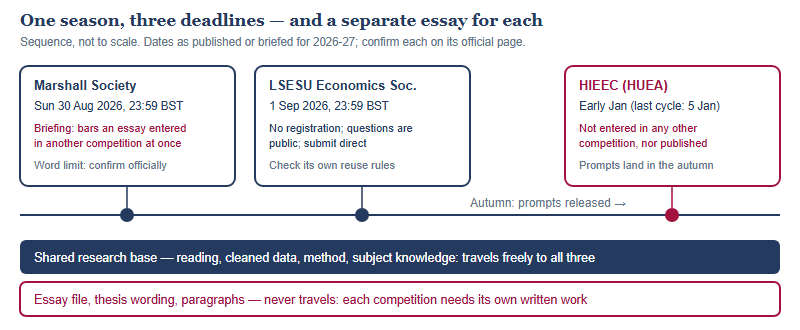
This year the collision is easy to see. Our lead economics coach wrote an internal breakdown of the 2026 Marshall Society Essay Competition on 9 August 2026 — the Marshall Society is Cambridge University’s economics society, founded in 1927 — and the briefing states the rules as follows. Treat this as our reading of the paper, and confirm every point on the official Marshall page and form before relying on it:
- Deadline Sunday 30 August 2026 at 23:59 British Summer Time, with no late marking.
- Submission only through the official Google form; emailed entries are refused.
- PDF, named as your name plus the question number, under a 10MB ceiling, with no edits after submitting.
- Times New Roman 12 with 1.5 line spacing and page numbers; the first page carries question number, title, author name and school.
- APA author-date citations with a source list at the end.
- Judged on logical argument, quality of evidence and originality.
- Generative AI is permitted for research; the writing must be your own; every use must be declared on the submission form; and all entries pass through similarity and AI-text screening, with disqualification for breaches.
- Critically: the competition bars entries that are submitted to any other competition at the same time.
One number we are deliberately not giving you is the word limit. Two operator briefings disagree — an earlier one says roughly 1,250 words, the August one says 1,500 including footnotes but excluding the reference list and data tables — and the official page did not carry the figure when we checked it on 31 July 2026. The limit is tight, footnotes count toward it on at least one reading, and you must confirm the exact figure on the official page and form before you write a sentence. Apply the same caution to any prize amount you see quoted on third-party sites.
Meanwhile the LSESU Economics Society essay competition closes on 1 September 2026 at 23:59 (BST), with no registration step — the questions are public and you submit directly through the society’s portal. Confirm that on the official LSESU page too.
So a student holding one strong economics essay in mid-August has roughly three weeks and a genuine decision: Marshall’s exclusivity clause means the essay cannot sit in both places at once. And the six Marshall questions this year point in a distinctly British direction — whether calling tariffs harmful is fair, how far a central bank can stabilise an economy against an external energy shock, how much of Britain’s 1930s recovery is owed to leaving the gold standard in September 1931, an evaluation of Andy Burnham’s economic and business policies as Greater Manchester mayor, whether the stock market is a good indicator of economic growth, and whether economics is a distinct discipline with a distinctive methodology. Those are Marshall’s questions, not HIEEC’s. HIEEC releases its own prompts in the autumn.
The season map, side by side
The useful comparison is not “which competition is more prestigious.” It is “what does each rulebook allow me to do with the work I already have.” Set them out in one table before you commit anything.
| Competition | Deadline (as published / briefed) | Same-essay-elsewhere rule | Confirm yourself before writing |
|---|---|---|---|
| Marshall Society (Cambridge economics society) | Sun 30 Aug 2026, 23:59 BST; no late marking | Per our briefing: bars entries submitted to any other competition at the same time | Word limit (briefings conflict), prize amounts, form fields, AI declaration |
| LSESU Economics Society | 1 Sep 2026, 23:59 BST; no registration step | Not verified by us — read the official rules directly | Question list, submission portal, whether edits are possible after sending |
| HIEEC (run by HUEA) | 2026-27: opens 26 Oct 2026; deadline 5 Jan 2027, 23:59 Eastern Time (6 Jan 2027, 12:59 Beijing); no late entries | Current 2026-27 page does not specify the old exclusivity rule; confirm with HUEA rather than assuming | Confirm prompts, deadline, fee, eligibility and integrity terms on thehuea.org and Tally form |
The lesson is not that HIEEC still has the same reuse rule. It is that competitions revise terms, and a rule you remember from an earlier cycle can mislead you. For 2026-27, confirm HIEEC’s current terms directly.
What travels, and what must not
The old clause barred the essay. It does not bar you from knowing things. Everything you built while writing an August essay — the twenty papers you read, the data series you cleaned, the mechanism you finally understood, the objection you learned to answer — is yours, and it makes the next essay dramatically faster to write. What cannot cross is written text.
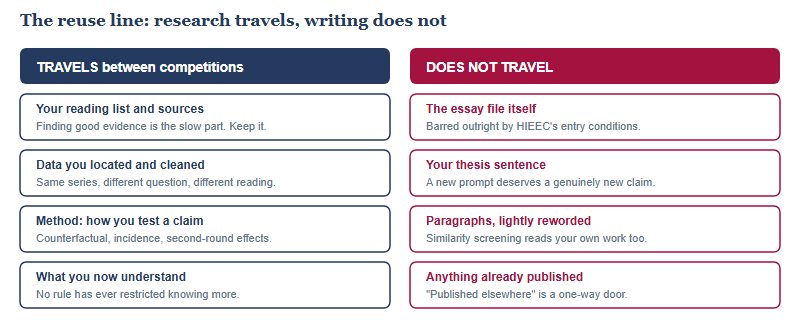
Two practical warnings. First, similarity screening does not distinguish between copying someone else and copying yourself; a paragraph you wrote in August and pasted into a January essay can still surface as matched text. Second, “lightly reworded” is the most dangerous category on that list, because it feels like effort. If you find yourself editing an old paragraph to fit a new question, you are almost always producing a worse paragraph than one written fresh for the new argument.
A sequence that actually works for 2026-27
Once you treat each competition’s current rules as controlling, the calendar becomes a pipeline rather than a conflict. The autumn prompt release is still convenient: you cannot pre-write a HIEEC entry in August, because the questions do not exist yet.
- Mid-to-late August: pick one late-summer home for the essay you have. Write it to that rulebook’s format, citation style and declaration requirements. Do not hedge by preparing to submit it twice.
- Autumn: HIEEC prompts land — for 2026-27, five set topics plus your own-question option; watch thehuea.org rather than assuming a month. The choices are the same for both divisions. Choose by your evidence access, not by which sounds most impressive; our guide to choosing a prompt by strength walks through that judgement.
- November to December: draft, then compress. A hard 1,500-word ceiling is a structural constraint, not a trimming exercise — see the method for building a 1,500-word essay.
- Early January: submit before the deadline of 5 January 2027 at 23:59 Eastern Time (6 January 2027, 12:59 Beijing). There are no late entries.
One honest note for families weighing a full season: entering three competitions means writing three essays, and three essays written quickly are usually worse than one written properly. If your autumn is already heavy with school deadlines and applications, a single well-argued HIEEC entry is a more sensible plan than a scattered sweep. Results vary in every competition, and no essay guarantees any outcome.
Frequently asked questions
Can I send my Marshall essay to HIEEC in January?
The old HIEEC exclusivity rule discussed in this article is not specified on the current 2026-27 page, so do not rely on it as current. Check the live rules and form with HUEA, and reuse research rather than risking an essay that another competition may treat as already submitted.
What if my August essay wins and gets published?
Publication elsewhere may matter under some competition rules, but the current HIEEC page does not specify the old exclusivity clause. Confirm with HUEA before assuming either way.
Can two of my own essays share the same sources?
Yes. Shared reading and data are normal. Shared sentences are not, and similarity screening at some competitions will catch them.
Does HIEEC issue a candidate ID before I write?
No advance ID is described in the published entry conditions. Confirm the live form on thehuea.org each cycle.
This is an independent guide operated by Hanlin Education for China-based international-school students. We are not affiliated with, endorsed by, or sponsored by the Harvard Undergraduate Economics Association, the Harvard College Economics Review, or Harvard University. Competition rules, deadlines, fees and prompts change each cycle — confirm current details on thehuea.org and on each competition’s own official page before you enter. Factual corrections are made within 7 working days.