For the 2026-27 HIEEC, the scope ladder turns a broad policy claim into a testable 1,500-word case by fixing three choices: the affected group, the policy instrument or comparison, and the time horizon. Those choices define what evidence the essay must examine and what it cannot claim.
HUEA’s HIEEC competition page, accessed 16 November 2026, caps the essay at 1,500 words including footnotes but excluding references, so scope is not decoration; it is the budget that makes a causal argument possible. The same page states that judges assess analysis, creativity, research and structure, each worth five points, for 20 total. A narrow scope does not earn those points by itself, but it lets the analysis and structure do visible work instead of gesturing at a whole economy.
In one teaching example about a host-country policy, the Hanlin Courses teaching analysis ‘2027 Harvard HIEEC Economics Essay Competition Prompt Analysis: A Penn Alumna’s Guide to Clarifying Ideas’, published 12 November 2026, recommends choosing one country and focusing on one or two main mechanisms. The same note advises breaking a broad national effect into affected groups, because universities, renters and firms may be affected differently. That is a teaching recommendation, not an official HUEA rule, but it addresses a practical constraint: 1,500 words cannot prove a national welfare claim for every actor and every adjustment channel.
Prompt selection is a separate decision. If you are still deciding which question to answer, the guide to Multi-Part HIEEC Prompts: Which Questions to Answer, Based on 16 Official Past Prompts (2026-27) handles that choice. This article begins after a prompt has been chosen: how do you turn its broad policy language into a case that can be argued and tested?
Why a National Claim Becomes Untestable at 1,500 Words
A sentence such as ‘this policy makes the country better off’ contains at least four hidden choices: better off for whom, through which instrument, compared with what, and over what period. Each choice adds evidence requirements. A national average can hide offsetting effects between groups, and a long-run claim can require data that a short essay cannot responsibly analyse.
The problem is not that national context is irrelevant. It is that national context cannot substitute for a causal chain. If the essay moves from a policy announcement to a national average without naming who changes behaviour and why, the reader cannot tell whether the outcome came from the policy, from another shock, or from a change in composition. The scope ladder makes those links explicit.
Rung 1: Name the Affected Group and the Margin
Start by replacing ‘society’, ‘the country’ or ‘the economy’ with an actor that has a measurable position. A renter, a landlord, a university, a firm, a commuter or a local shop does not respond to a policy in the same way. Each has a different budget, a different margin of adjustment and a different time frame. The Hanlin note’s example is useful here: a host-country measure may affect universities through fees and research resources, renters through housing costs, and firms through the supply of graduates. A national claim that merges them is not wrong, but it is too coarse for a short causal argument.
Then name the margin. For a renter, the relevant margin might be monthly housing cost, moving decision or household saving. For a university, it might be tuition revenue, admission offers or research staffing. For a firm, it might be hiring, training or location. Pick one primary margin and one primary group. Other groups can appear in the counterargument or limitations, but they should not each receive a full mechanism. A useful test is whether you can state the group and margin in one sentence without using the word ‘everyone’.
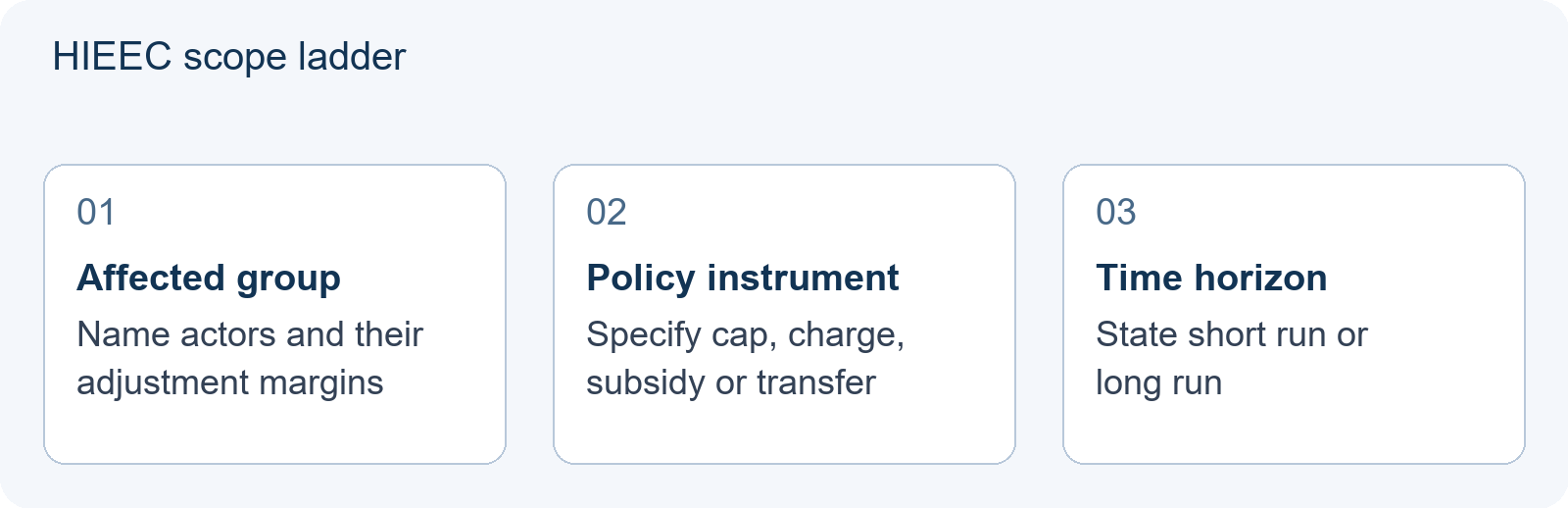
Rung 2: Specify the Policy Instrument or Comparison
‘The government should help’ is a goal, not an instrument. A cap, a charge, a subsidy and a transfer change behaviour through different channels. A cap restricts quantity and may create rationing or non-price allocation. A charge raises the marginal cost of a behaviour and works through price. A subsidy lowers a cost or raises a return. A transfer changes income without directly changing a price. If the essay mixes them, the reader cannot tell which mechanism is being tested.
The comparison is equally important. A policy can be compared with no policy, with a different instrument, with a previous version of the same instrument, or with a matched area outside the policy. Each comparison answers a different question. ‘Did the policy change behaviour?’ is not the same as ‘Was this instrument better than the alternative?’ A 1,500-word essay should defend one main comparison. If a draft contains two countries, three instruments and several outcomes, the causal chain is probably being carried by assertion rather than evidence.
Rung 3: Set the Time Horizon
Short-run adjustment and long-run equilibrium are different claims. In the short run, people may change timing, route or supplier while keeping larger choices fixed. In the long run, they may move, invest, enter or exit. A six-month evaluation of a transport charge can observe diversion and retiming; it cannot establish long-run changes in where people live and work. A long-run claim may be more interesting, but it needs evidence capable of speaking to that horizon.
State which horizon the essay is judging and treat the other as a limitation or extension. This is not a stylistic preference. It prevents a common mismatch in which short-run data are used to support a long-run welfare conclusion. The guide to HIEEC Essay Counterfactuals: State What Would Have Happened Without the Policy is a useful companion because the time horizon also defines what ‘would have happened otherwise’ means.
Worked Hypothetical: From a City-Wide Claim to a Testable Transport-Pricing Case
The following is an original teaching illustration, not a contest prompt and not evidence that any real city’s policy produced these results. Suppose a draft says: ‘A congestion charge makes a city better off.’ The scope ladder narrows it in three moves.
- Affected group: peak-hour private-car commuters entering a defined central zone. A secondary group is central retail shops, used only in the counterargument.
- Instrument and comparison: a weekday peak charge for private cars crossing a cordon, with buses, emergency vehicles and disabled drivers exempt; compare the charged zone with a matched ring outside the cordon over the same period.
- Time horizon: the first 12 months after introduction.
The primary testable claim becomes: ‘In the first 12 months, a weekday peak cordon charge for private cars reduces charged-hour private-car crossings into the central zone, relative to a matched comparison area.’ The mechanism is a higher marginal cost of a peak car trip, leading some commuters to switch to bus, retime or reroute.
This claim depends on a stated premise: the comparison ring is similar enough that differential shocks are not driving the result. The counterargument asks whether central-zone retail sales fall relative to the comparison area, or whether delivery costs rise. That retail check is secondary evidence about the counterargument, not a second primary outcome. The essay would not assert the result; it would ask whether available traffic counts and sales data can discriminate between the mechanism and the counterargument. If the data cannot, the honest conclusion is about what remains uncertain, not a city-wide welfare verdict.
A Word Budget for 1,500 Words
The table below is a planning target, not an official HUEA requirement. It protects the mechanism and counterargument from being squeezed out by background. HUEA counts footnotes inside the 1,500-word maximum but excludes references.
| Section | Question it answers | Target words |
|---|---|---|
| Scope and definitions | Which group, instrument, comparison and horizon? | 130 |
| Mechanism chain | How does the instrument change the group’s margin? | 300 |
| Evidence and source evaluation | What data can test the mechanism and comparison? | 410 |
| Counterargument and alternative explanation | What else could produce the same pattern? | 300 |
| Institutional context | What rules, exemptions or constraints matter? | 180 |
| Introduction and conclusion | What is claimed, and what remains limited? | 120 |
| Footnotes and signposting | Can a reader trace the argument without extra background? | 60 |
| Total | Within the 1,500-word cap | 1,500 |
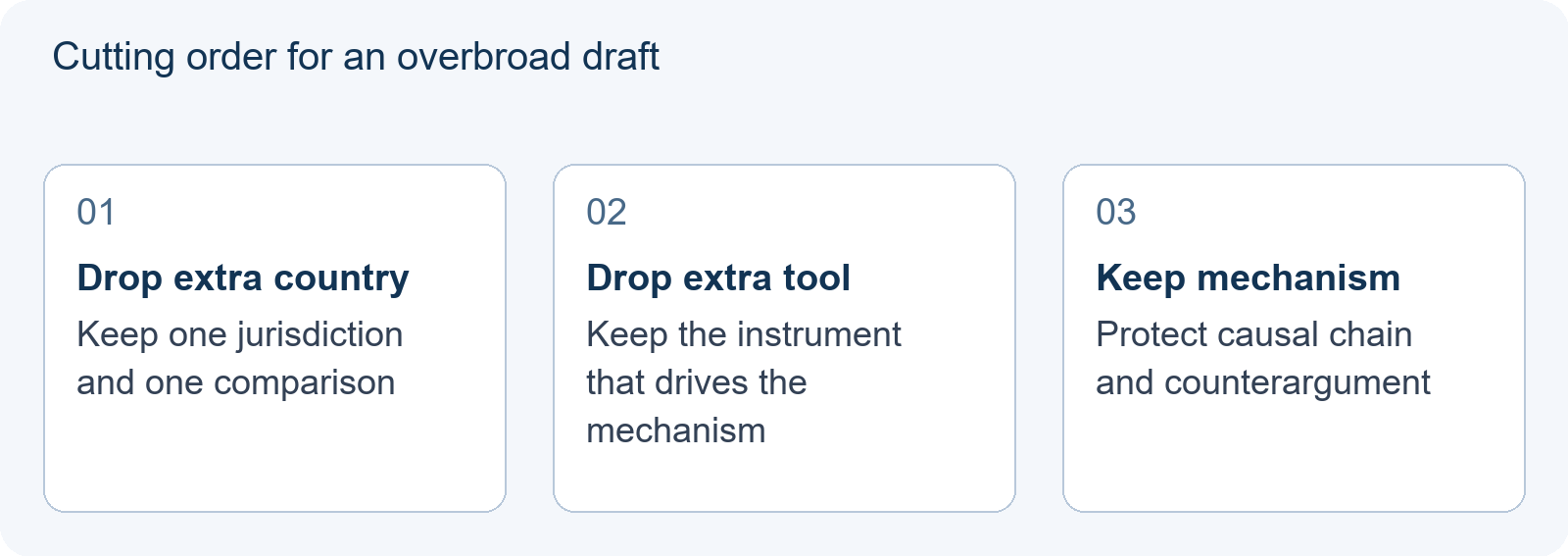
Cutting Rule: What to Remove First
When a draft is overbroad, remove extra jurisdictions before removing the mechanism. Then remove extra policy instruments. Then remove secondary outcomes that are not needed to test the main claim. Keep the causal chain and the strongest counterargument. Prioritise a clear comparison over a second country. Prioritise the chosen instrument’s mechanism over a third instrument. Move secondary affected groups into one limitation sentence rather than giving each a separate paragraph.
This rule also helps when you are deciding whether to rescue a draft. The guide to When to Abandon Your HIEEC Draft and Switch Prompts: A Decision Rule for the Autumn Term addresses the larger decision; the cutting rule addresses a draft whose prompt still fits but whose scope has grown too wide.
Final Scope Sentence and Review Preparation
End the planning stage with one sentence: ‘In [jurisdiction] during [time horizon], I evaluate whether [instrument or comparison] changes [primary outcome] for [affected group] through [mechanism], while considering [main counterargument].’ Add a second sentence on what the essay will not show, such as economy-wide welfare or long-run location effects. If that second sentence is difficult to write, the scope is probably still too broad.
A final technical checklist before drafting: does the scope sentence name one group and one margin; does it identify one instrument and one comparison; does it state a horizon; does the evidence paragraph name a source capable of testing the mechanism; and does the counterargument challenge the same causal chain rather than introduce a new topic? These are planning checks, not HUEA scoring rules.
When preparing a scope review with a teacher or adviser, bring the scope sentence, the mechanism chain, the comparison, the evidence list and the word budget. State whether you need help finding background reading, checking data availability or testing the counterargument. A useful request is specific enough that a teacher or adviser can respond to the argument rather than guess what the essay is trying to prove. This independent guide is not affiliated with HUEA; current rules should be checked on the HUEA HIEEC competition page.
Frequently Asked Questions
Can a 1,500-word HIEEC essay cover a whole country?
It can discuss a national policy, but the testable case usually needs a named affected group, a specific instrument or comparison, and a stated time horizon. HUEA caps the essay at 1,500 words including footnotes but excluding references, so national context should support the case rather than replace it.
Should I choose short-run or long-run effects?
Choose one as the primary judgment and treat the other as a limitation or extension. A short-run claim about adjustment costs is different from a long-run equilibrium claim, and the evidence needed for each is different.
What if my draft already has two countries and three policies?
Cut extra jurisdictions first, then extra instruments, then secondary outcomes. Keep the mechanism and the strongest counterargument. Move secondary groups into a brief limitation rather than giving each one a full analysis.